In this composition lesson, we will explore the golden ratio — what it is, how to find it, why it is used, and what to look for in an image.
Background Knowledge About the Golden Ratio
The golden ratio is a mathematical proportion that has been used in art and architecture for thousands of years. It is a ratio considered to be particularly harmonious and aesthetically pleasing to the human eye.
The golden ratio is calculated by dividing a line into two parts in such a way that the ratio between the smaller part and the larger part is the same as the ratio between the larger part and the whole line. This ratio corresponds to approximately 1.618 to 1.
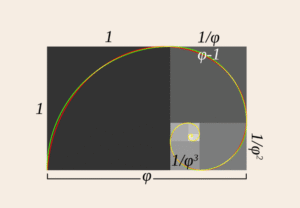
The golden ratio can also be represented as a spiral, where each step of the spiral’s rotation follows the same proportional relationship. This spiral form appears in nature — from galaxies to seashells — and is believed to have a special visual appeal.
In art and architecture, the golden ratio has been used as a guideline for creating aesthetically pleasing proportions and balance. For example, it can be applied to position key elements in an image or to establish harmonious proportions in a building.
Although the golden ratio is a mathematical concept, whether it works well in a specific artwork or design remains a subjective aesthetic decision. Many artists and designers use the golden ratio as a guide, but it is not an absolute rule for what makes a composition visually appealing.
What Is the Golden Ratio?
Definition:
The golden ratio is a mathematical proportion that occurs when a line or segment is divided into two parts so that the ratio between the smaller and the larger part is the same as the ratio between the larger part and the whole. This proportion is often considered especially harmonious and visually pleasing, and it is used in art and design to guide proportion and balance. The golden ratio equals approximately 1.618 to 1 and can also be represented as a spiral known as the Fibonacci spiral.
Why Use the Golden Ratio?
If you want to create harmony in an image, the golden ratio is an excellent technique to use. The eye will naturally be drawn toward the important area of the composition, and we intuitively understand this prioritization from the artist’s intent.
What Is the Golden Ratio Used for in Images?
The golden ratio is a technique for placing the most important elements of an image in a visually pleasing way. Our eyes do not naturally rest at the exact center of an image; instead, we tend to look slightly to the left or right of center. The golden ratio helps to achieve visual balance and make the composition more comfortable for the eye.
When and Where Can You Use the Golden Ratio?
The golden ratio can be used as a guideline to create harmonious and proportionate designs across many disciplines, including:
- Art: Artists can use the golden ratio to position focal points or achieve balance and harmony in their compositions.
- Photography: Photographers can use it to place subjects in the frame, creating natural visual flow and balance.
- Architecture: Architects can use it to design spaces and structures with pleasing proportions and visual order.
- Graphic design: Designers can apply it to arrange elements harmoniously in layouts and branding.
- Fashion: Clothing designers can use it to create balanced and aesthetically refined designs.
- Landscape design: Landscape architects can apply it to create natural, visually balanced environments.
It is important to remember that the golden ratio is a guideline, not a rigid rule. Sometimes designers achieve more interesting or unique results by breaking away from it and thinking creatively outside the norm.
How to Find the Golden Ratio
Here is a video that explains how to locate the intersection points of the golden ratio. You can also simply use a drafting compass on a printed layout:
How to Find the Golden Ratio:
- Draw a rectangle and divide it according to the 1:1.618 ratio.
- Mark the intersection lines.
- The key focal points where these lines cross are often where the viewer’s attention naturally rests.
The Golden Ratio in Painting
Painting, like other art forms, has often been ascribed almost magical qualities — and it is indeed fascinating how mathematically measurable constructions can create proportions that feel perfectly harmonious.
During the Renaissance, proportions based on the golden ratio were considered expressions of divine order.
Calculating the Golden Ratio
The golden ratio can be calculated by dividing a line into two parts so that the ratio between the smaller part and the larger part is the same as the ratio between the larger part and the whole. This relationship corresponds to approximately 1.618 to 1.
If we call the smaller segment “a,” the larger segment “b,” and the total line “a + b,” the ratio can be expressed as:
b / (a + b) = (a + b) / a
Solving this equation gives the relationship between a and b that equals the golden ratio:
b / (a + b) = (a + b) / a
b * a = (a + b)²
b * a = a² + 2ab + b²
a² – ab – b² = 0
The solutions to this quadratic equation are:
a = (1 + √5) / 2 * b (positive solution)
a = (1 – √5) / 2 * b (negative solution)
The positive solution corresponds to the golden ratio (≈1.618), while the negative corresponds to the inverse golden ratio (≈0.618).
Another way to approximate the golden ratio is through the Fibonacci sequence, but the equation above remains one of the most common methods.
Examples of the Golden Ratio
The golden ratio can be observed in:
- Leonardo da Vinci’s Vitruvian Man
- The Parthenon in Athens
- Salvador Dalí’s The Sacrament of the Last Supper
- Modern design and photography composition using the Fibonacci spiral or “rule of thirds” as simplified forms.