Cubism is an art movement born in the early 20th century that revolutionized the way artists represented reality.
By breaking away from traditional forms and perspectives, Cubism opened the door to a new era of experimental and abstract art that challenged the viewer’s perception of space, time, and movement.
The History of Cubism
The roots of Cubism can be traced back to Paris around 1907, when artists such as Pablo Picasso and Georges Braque began exploring new ways to depict the world on canvas. Inspired by African and pre-Columbian art forms, they started to deconstruct recognizable shapes and objects, transforming them into abstract geometric structures. Cubism quickly became one of the most influential art movements of the 20th century, setting the stage for the rise of modern art.
Characteristics of Cubism
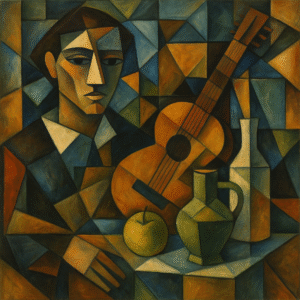
Cubist artworks are defined by their use of geometric forms, multiple viewpoints, and the fragmentation of objects and figures. Artists within the movement sought to represent all sides of an object or scene simultaneously, creating a multidimensional vision of reality. Cubism was not merely an aesthetic experiment — it was also a philosophical exploration of time, space, and perception.
Cubism Today
Although the original Cubist movement reached its peak during the early 20th century, its influence remains visible in modern art and culture. Contemporary artists and designers continue to draw inspiration from Cubism’s abstract shapes and sharp lines, and its impact can be seen in everything from painting and sculpture to fashion and architecture. Cubism also paved the way for other experimental movements such as Constructivism and Abstract Expressionism, which built upon its innovative approach to form and perspective.
Challenging Tradition
Cubism represented a radical break from traditional art forms and perspectives, ushering in a new era of experimentation and abstraction. Through the use of geometric shapes and fragmented forms, Cubism invited viewers to see the world from a new angle — one that celebrated complexity, dynamism, and multiple realities.
Even today, Cubism continues to inspire and fascinate both artists and audiences, reminding us of the importance of thinking beyond conventions and daring to challenge tradition.