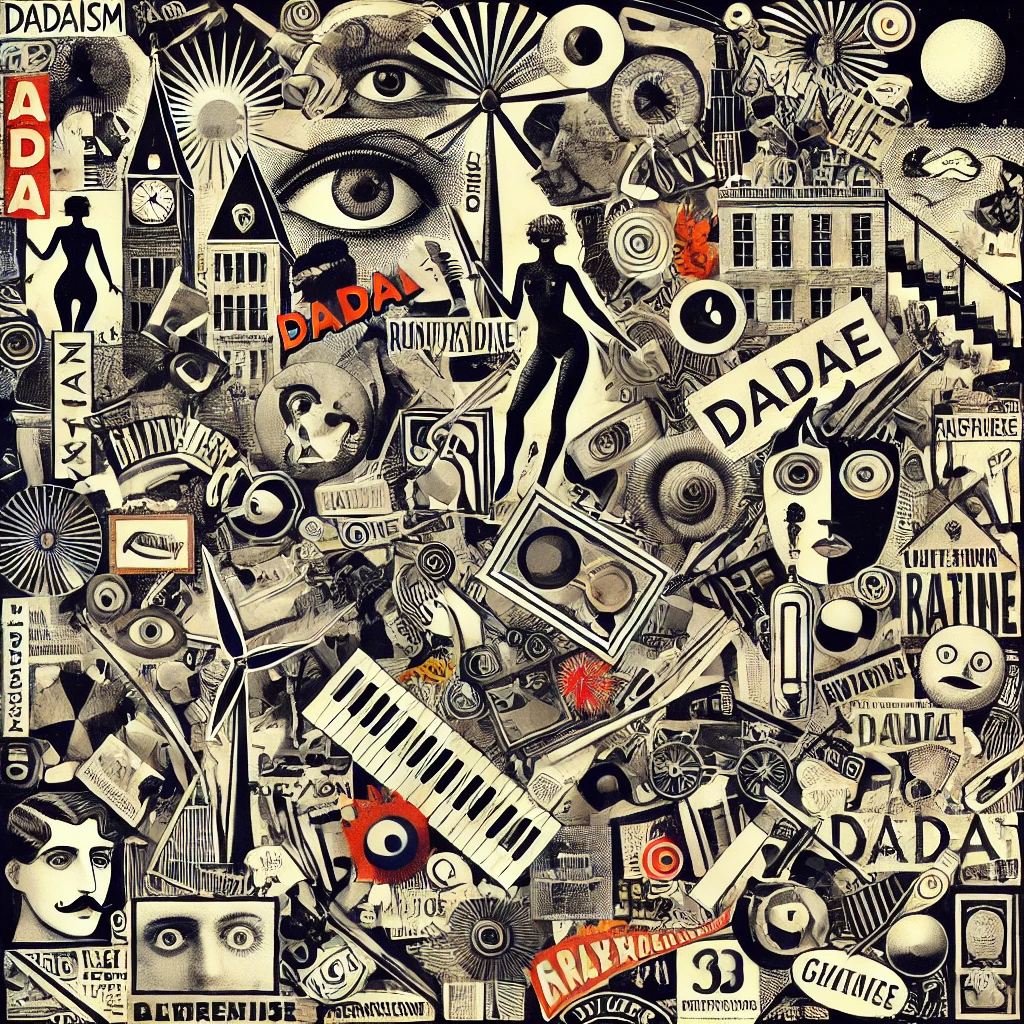
Dadaism was an art movement or art form that lasted for about ten years, from around 1915 to 1925.
The movement got its name Dada from the German writer Hugo Ball, who ran Cabaret Voltaire in Zürich together with his wife Emmy Hennings.
Dada cultivated the meaningless, the absurd, and the random, and was in its nature anti-authoritarian and anarchistic, with total contempt for all established norms, both moral and aesthetic.
Dadaism is an art movement that arose in Zürich in 1916 as a reaction to the First World War. The Dadaists criticized society and logical thought, and their works were often absurd and provocative. Dadaism developed into an international movement, and many of the most well-known artists and writers were Dadaists, including Marcel Duchamp and Tristan Tzara.
Dadaism Definition
Dadaism was an anti-art movement that shared traits with Futurism in its rebellious attitude and in the blurring of boundaries between art and reality.
What Was Neo-Dadaism?
Neo-Dada was a movement with sound, visual, and literary manifestations that had similarities in method or intention to earlier Dada artworks.
Neo-Dada sought to close the gap between art and everyday life and was a combination of playfulness, iconoclasm, and appropriation. In the United States, the term became popular through art historian and critic Barbara Rose in the 1960s and refers primarily to work created in that and the preceding decade.
There was also an international dimension to the movement, especially in Japan and Europe, which served as the basis for Fluxus, Pop Art, and Nouveau Réalisme.
Neo-Dada is exemplified by the use of modern materials, popular imagery, and absurd contrasts. It was a reaction against the emotional subjectivity of Abstract Expressionism and rejected traditional concepts of aesthetics.
Characteristics of Dadaism
- Collages
- Readymades
- Photomontages
- Objects that normally do not belong in the art world
- Theatre
- Sound poems
- Earth tones + black and white
All norms were ignored, and art became provocation.
The Dadaists broke with classical artistic ideas and forms.
A good example of this was Marcel Duchamp’s Fountain, which was a signed urinal that was rejected for an art exhibition at the Grand Central Palace in New York.
Marcel Duchamp (1887-1968) was a French visual artist and art theorist. Some call him the forefather of conceptual art.
Dadaist Painting
Dadaism was mostly practiced in other techniques, but paintings of a futurist and constructivist nature are also seen.
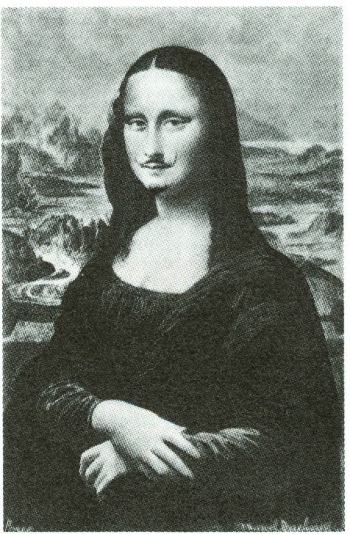
An example of painting is the mustache on the Mona Lisa by Marcel Duchamp.
Dadaist Manifesto
In 1916 Hugo Ball published the first Dada Manifesto, and to emphasize the sarcasm of Dadaism he chose to perform his sound poem Karawane from the same year wearing a suit made of shiny blue cardboard and a witch’s hat.

The Dadaist Manifesto Translated into English
Dada is a new tendency in art. One can tell this from the fact that until now no one knew anything about it, and tomorrow everyone in Zürich will be talking about it.
Dada comes from the dictionary. It is terribly simple. In French it means “hobbyhorse.” In German it means “farewell,” “get off my back,” “see you sometime.” In Romanian: “Yes, truly, you are right, that’s it. But of course, yes, certainly, correct.” And so on.
An international word. Just a word, and the word a movement. Very easy to understand. Quite terribly simple. To make it into an artistic tendency must mean to anticipate complications. Dada psychology, Dada Germany cum indigestion and fog paroxysm, Dada literature, Dada bourgeoisie, and you yourselves, esteemed poets, who always write with words but never write the word itself, who always write around the actual point. Dada world war without end, Dada revolution without beginning, Dada, you friends and also—poets, esteemed sisters, producers and evangelists. Dada Tzara, Dada Huelsenbeck, Dada m’dada, Dada m’dada Dada mhm, Dada dera Dada, Dada Hue, Dada Tza.
How does one achieve eternal bliss? By saying Dada. How does one become famous? By saying Dada. With a noble gesture and delicate honesty. Until one goes mad. Until one loses consciousness. How can one get rid of everything that tastes of journalism, worms, all that is neat and proper, blinkered, moralistic, Europeanized, preserved? By saying Dada. Dada is the soul of the world, Dada is the pawnbroker. Dada is the world’s best lily-milk soap. Dada Mr. Rubiner, Dada Mr. Korrodi. Dada Mr. Anastasius Lilienstein. In plain language: Swiss hospitality is something to be deeply appreciated. And in matters of aesthetics, the key is quality.
I shall read poems intended to dispense with conventional language, no less, and have done so. Dada Johann Fuchsgang Goethe. Dada Stendhal. Dada Dalai Lama, Buddha, Bible, and Nietzsche. Dada m’dada. Dada mhm Dada da. It is a matter of connections and of loosening them up a little to begin with. I don’t want words that other people have invented. All the words are other people’s inventions. I want my own stuff, my own rhythm and vowels and consonants too, that fit my rhythm and all my own. If this pulsation is seven meters long, I want words for it that are seven meters long. Mr. Schulz’s words are only two and a half centimeters long.
This will serve to show how articulated language comes into being. I let the vowels fool around. I let the vowels simply appear, as a cat meows… Words appear, word-shoulders, legs, arms, word-hands. Au, oi, uh. One shouldn’t let too many words out. A poem is a chance to get rid of all the filth that clings to this damned language as though put there by the hands of stockbrokers, hands worn smooth by coins. I want the word where it ends and begins. Dada is the heart of the word.
Each thing has its word, but the word has become a thing in itself. Why shouldn’t I find it? Why can’t a tree be called Pluplusch and Pluplubasch after it has rained? The word, the word, the word outside your domain, your stuffiness, this ridiculous impotence, your fantastic smugness, outside all the parroting in your self-evident limitation. The word, gentlemen, is a public concern of the first importance.
— Hugo Ball
The End of Dadaism
Dadaism was followed by Surrealism, which began to gain momentum in the early 1920s.