Pablo Picasso, one of the most influential artists of the 20th century, revolutionized the art world with his innovative approach and extraordinary talent.
An Introduction to the World of Pablo Picasso
Before diving into his most iconic works, it’s important to understand the artistic context in which Picasso operated. Born in Málaga, Spain, in 1881, Picasso showed remarkable skill in drawing and painting from an early age. He received formal art training, but it was his experimental spirit and constant search for new forms of expression that made him the groundbreaking artist we know today.
Picasso’s career can roughly be divided into several phases — the Blue Period, the Rose Period, the African Period, and Cubism. Each reflects different influences and artistic interests, but it is Cubism for which Picasso is best known. Together with Georges Braque, he developed this revolutionary style that broke away from traditional perspective and representation.
Picasso’s Most Famous Paintings
Here is a selection of Pablo Picasso’s most famous paintings that have left a lasting mark on art history:
Guernica (1937)
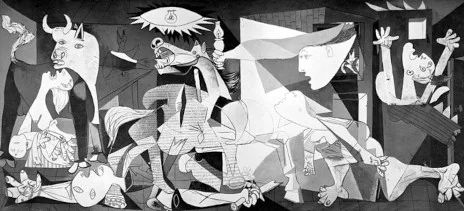
Guernica (1937)
Guernica is undoubtedly one of Picasso’s most powerful and iconic works. The painting was created as a response to the bombing of the Basque town of Guernica during the Spanish Civil War. It delivers a strong anti-war message, depicting the horrors of war and human suffering through a black, white, and gray palette. Guernica stands as a masterpiece of composition and emotional expression and has since its creation become a universal symbol of peace and protest against violence.
At Kunstskolen.dk, we emphasize the importance of composition in art. You can learn more about this subject in our composition course.
Les Demoiselles d’Avignon (1907)

ChatGPT said:
Les Demoiselles d’Avignon (1907)
Les Demoiselles d’Avignon, or The Young Ladies of Avignon, is another of Picasso’s groundbreaking works. This painting is often considered the first truly Cubist artwork, although it still carries elements of African art and Expressionism. It depicts five prostitutes in a stylized, fragmented form that breaks with traditional portrayals of the human body. The painting shocked its contemporaries but opened the door to a completely new way of seeing and representing the world.
Three Musicians (1921)
See the painting here.
Three Musicians exists in two versions and is an excellent example of Picasso’s Synthetic Cubism. The painting portrays three costumed figures as musicians, with shapes and colors simplified into geometric forms. Though abstract, the figures and their instruments remain clearly recognizable. Three Musicians is a lively and dynamic work that demonstrates Picasso’s ability to merge abstraction with figuration.
Are you interested in the meaning of color in art? Explore our color theory section.
Dora Maar au Chat (1941)
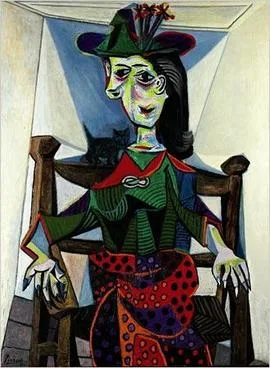
This portrait of Dora Maar, Picasso’s lover and muse, is an example of his ability to capture personality and emotion in his paintings. Dora Maar was a talented photographer and artist in her own right, and she had a significant influence on Picasso’s work. In Dora Maar au Chat, she is depicted seated on a chair with a cat by her side. The painting is characterized by its bold colors and expressive brushstrokes, giving Dora Maar a powerful and mysterious presence.
The Weeping Woman (1937)

The Weeping Woman (1937)
The Weeping Woman is a series of paintings depicting a woman in deep sorrow. These works were inspired by Guernica and can be seen as a continuation of the themes of pain and suffering. The woman is portrayed with distorted features and sharp, contrasting colors that emphasize her emotional state. The Weeping Woman is a powerful expression of human grief and despair.
Pablo Picasso’s Influence on Modern Art
Pablo Picasso’s influence on modern art cannot be overstated. He was one of the most innovative and influential artists of the 20th century, and his work has inspired generations of artists. His experiments with form, color, and perspective revolutionized the art world and opened the door to new forms of expression. From Cubism to Surrealism, Picasso helped define modern art and its development.
Pablo Picasso: A Master of Many Techniques
Although Picasso is best known for his paintings, he was also a talented sculptor, printmaker, and ceramic artist. He constantly experimented with different materials and techniques, and his versatility is proof of his artistic genius.
Understanding Picasso’s Blue Period
The Blue Period (1901–1904) marks a crucial stage in Pablo Picasso’s artistic evolution. Characterized by melancholic blue and blue-green tones, this phase reflects a profound sense of sadness and empathy for society’s marginalized individuals. Works from this period, such as The Old Guitarist and La Vie, often portray poverty, loneliness, and suffering. The dominance of blue enhances the emotional depth of the paintings. This was a time of personal and artistic challenges for Picasso, and the period left a lasting mark on art history.
Below is a table of some of Picasso’s most well-known works from the Blue Period:
| Title | Year | Description |
|---|---|---|
| The Old Guitarist | 1903 | An elderly man playing guitar. |
| La Vie | 1903 | Depicts a couple and a child. |
| The Blind Man’s Meal | 1903 | A blind man sitting at a table. |
Transition to the Rose Period
Following the melancholy of the Blue Period came the Rose Period (1904–1906), a time of lighter colors and more optimistic subjects in Picasso’s art. Pink and orange tones dominate, while themes shift to circus performers, harlequins, and family life. This period reflects a phase of personal happiness and artistic experimentation. The figures often express a gentle vulnerability and poetry, but the overall atmosphere is warmer and more positive. The transition to the Rose Period marks a vital step in Picasso’s evolving artistic expression.
Picasso’s Cubism: A Revolutionary Style
Cubism, developed by Picasso and Georges Braque, is one of the most revolutionary styles in art history. It broke away from traditional perspectives and representation by fragmenting objects and depicting them from multiple viewpoints simultaneously. This created a new way of seeing and understanding the world and had a massive influence on subsequent art movements.
Learn to Paint Like Picasso
Inspired by Pablo Picasso’s most famous paintings? Try these exercises to explore his style:
- Find a photo of a face. Sketch it with a few lines, then transform it into a Cubist composition showing three or four angles at once.
- Paint a simple subject (like a guitar or bottle) using contrasting colors and large flat shapes. Picasso often played with contrasts — strong primary colors against muted tones.
- Choose an animal or person. Draw it with your eyes closed or without lifting your pencil from the paper, then add unconventional color combinations.
Picasso’s Techniques and Materials
Picasso was a master of diverse techniques and materials. He constantly experimented with new ways of expressing himself, demonstrating his artistic range and curiosity. He often used oil, acrylic, and watercolor paints, as well as various drawing and printmaking techniques.
At Kunstskolen.dk, we emphasize the importance of understanding materials and techniques. Visit our section on art materials.
Frequently Asked Questions About Pablo Picasso’s Most Famous Paintings
Guernica is often considered Picasso’s most famous painting due to its strong anti-war message and iconic status.
Pablo Picasso is best known for Cubism, a revolutionary style he developed with Georges Braque.
Guernica was inspired by the bombing of the Basque town of Guernica during the Spanish Civil War.
The Blue Period (1901–1904) is defined by melancholic blue and blue-green tones depicting poverty and suffering.
At Kunstskolen.dk, we offer courses in various painting techniques that can help you develop your artistic skills and learn more about Picasso’s methods.
Picasso often used oil, acrylic, and watercolor paints, as well as different drawing and printing techniques.
By experimenting with different techniques, materials, and forms of expression, you can discover your own unique artistic style.