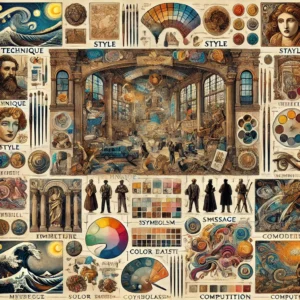

Art Nouveau, also known as Jugendstil, is an art movement from the late 19th and early 20th centuries. The style is characterized by its organic, flowing lines and natural forms, often inspired by plants and flowers. The Art Nouveau movement influenced many areas, including architecture, furniture design, glass art, textiles, and jewelry.
The Art Nouveau style emerged as a reaction against the Industrial Revolution and the mass production that came with it. It represented a return to craftsmanship and a celebration of the natural world. Today, the influence of Art Nouveau can still be seen in modern design and architecture, where its organic aesthetics and intricate patterns continue to inspire artists and designers.
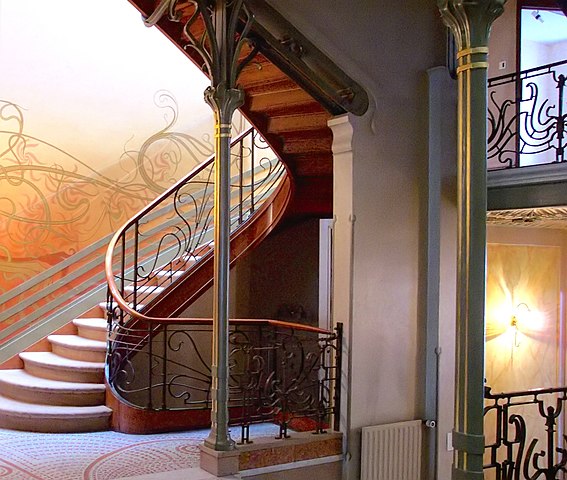
Victor Hortas Hôtel Tassel i Bruxelles fra 1893, er et skelsættende Art Nouveau værk, hvor innovation, skønhed og funktionalitet forenes. Hotellet repræsenterer en banebrydende tilgang til arkitektur, hvor form og funktion smelter sammen på en hidtil uset måde. Det er på UNESCO-verdensarvsliste.
Bygningen er opdelt i tre hovedsektioner: en frontbygning, en bagbygning og en centralt placeret hal med et glasoverdækket atrium, der skaber en visuel og funktionel forbindelse mellem de forskellige dele af huset.
Horta tegnede Hôtel Tassel med tanke på både æstetik og komfort. De åbne rum og den glidende overgang mellem indendørs og udendørs, skaber en følelse af sammenhæng mellem bygningens afdelinger. De mange indbyggede møbler og smarte opbevaringsløsninger viser Hortas forståelse for praktisk anvendelighed uden at gå på kompromis med æstetikken.
Facaden af Hôtel Tassel er en harmonisk sammensætning af sten, smedejern og glas. Horta integrerede bølgende, organiske linjer i facadens design, hvilket skaber en dynamisk og levende overflade.
En af de mest bemærkelsesværdige egenskaber ved Hôtel Tassel er Hortas brug af lys. Det centrale atrium med glasloft tillader naturligt lys at trænge dybt ind i bygningen´. Dette lys spiller en vigtig rolle i at fremhæve de dekorative elementer og materialernes skønhed.
Antoni Gaudí: Sagrada Família
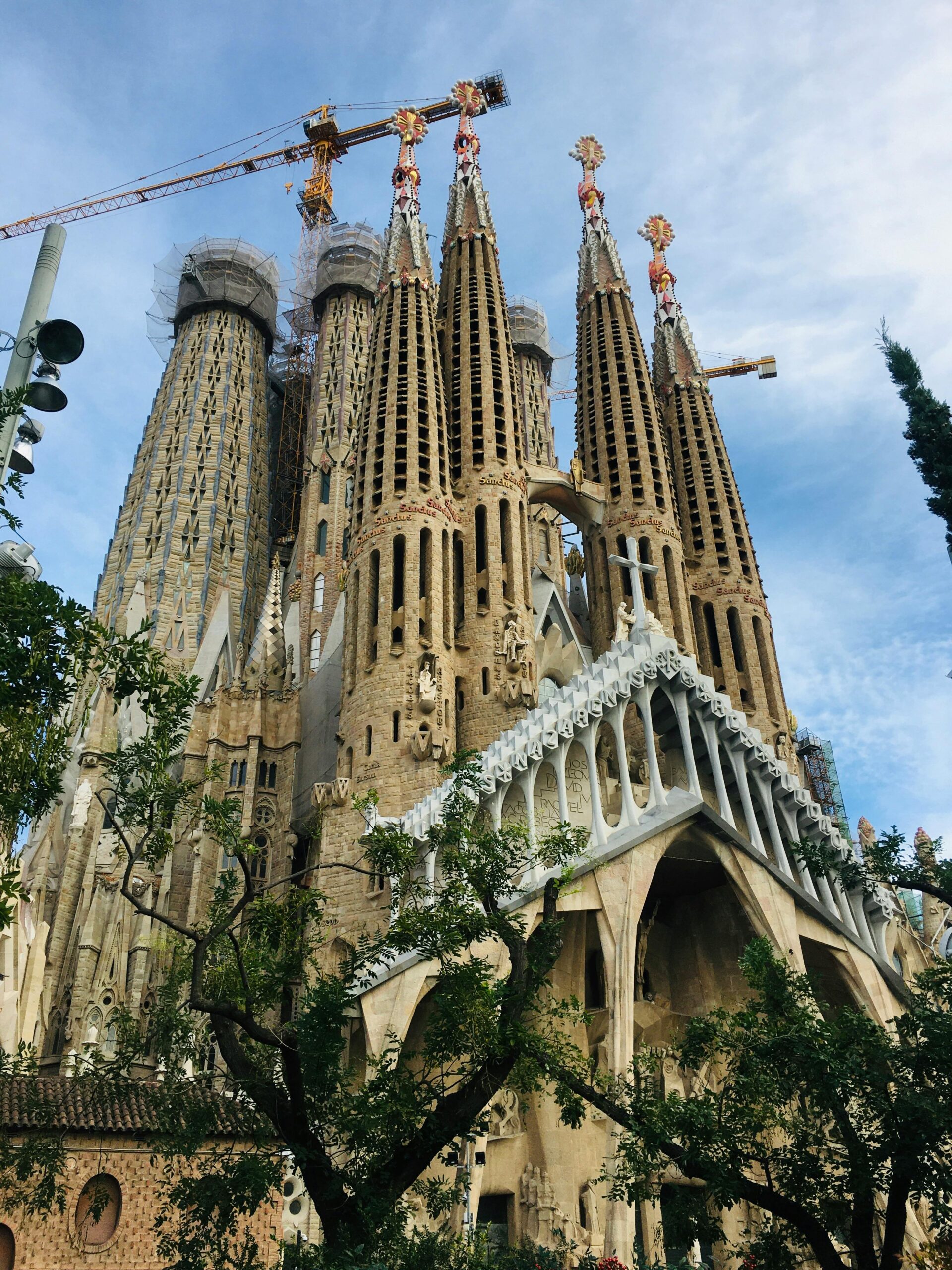
Sagrada Família in Barcelona, begun in 1882 and taken over by Antoni Gaudí in 1883, is considered a masterpiece of architectural modernism. The church is an iconic example of Gaudí’s unique style, where Gothic and Art Nouveau elements blend in a highly distinctive way. Gaudí worked on the church for over 40 years but never completed it, and construction continues to this day.
The church features three main façades — Nativity, Passion, and Glory — each representing a different aspect of Christ’s life. The Nativity façade, the most ornate of the three, is filled with natural and biblical symbolism.
Gaudí used complex geometric forms in his design for Sagrada Família. The interior is conceived as a forest, with tree-like columns branching out to support the ceiling. Stained-glass windows filter light into the space, creating a kaleidoscopic display of color.
Every element of Sagrada Família carries deep symbolism. The twelve spires represent the twelve apostles, while the central spire symbolizes Jesus Christ, surrounded by towers representing the Virgin Mary and the four Evangelists.
Sagrada Família is listed as a UNESCO World Heritage Site and stands as a defining symbol of Barcelona. It reflects Gaudí’s visionary approach and deep religious devotion. He once said, “My client is not in a hurry,” referring to God — a statement that perfectly captures his patient, meticulous dedication to the project.
Park Güell
Park Güell, also in Barcelona, was originally planned as a residential park by Gaudí’s patron, Eusebi Güell. The project began in 1900 but was eventually transformed into a public park.
The park is designed with a blend of natural and organic shapes, showcasing Gaudí’s characteristic use of colorful mosaics. One of its most famous features is the long, undulating mosaic bench that curves around the main terrace.
Gaudí used local materials and employed the trencadís technique — a method using broken ceramic tiles to create vibrant mosaic patterns. The main entrance features two whimsical buildings with mushroom-like roofs and twisting shapes. Across the park, aqueducts, colonnades, and stairways blend seamlessly into the surrounding landscape.
Symbolism is woven throughout the park’s design, combining religious and political references. The iconic salamander statue, El Drac, covered in vivid mosaics, is thought to represent alchemy or the Catalan flag.
Park Güell is also a UNESCO World Heritage Site and remains one of Barcelona’s most visited attractions.
Hector Guimard: Le Castel Béranger
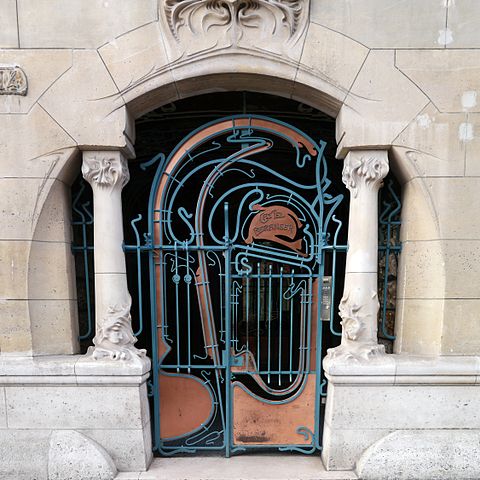
Le Castel Béranger was the first Art Nouveau residential building in Paris, constructed between 1895 and 1898 — an iconic work where beauty, innovation, and functionality unite in an entirely new way.
The building contains 36 apartments and is known for its asymmetrical structure and its mix of materials such as stone, brick, and wrought iron. Guimard incorporated flowing, organic lines into both the façade and the interior, creating a dynamic and vibrant design.
Guimard designed Castel Béranger with both aesthetics and comfort in mind. The open spaces and smooth transitions between interior and exterior create a sense of harmony throughout. Built-in furniture and clever storage solutions demonstrate Guimard’s ability to combine practicality with artistic beauty.
The façade of Castel Béranger is a balanced composition of varied materials and textures. Guimard used detailed wrought ironwork and colored glass to form a distinctive façade that perfectly embodies the Art Nouveau style.
One of the most remarkable aspects of Castel Béranger is Guimard’s use of light and color. Large windows and stained-glass panels allow natural light to flood the interior, enhancing the decorative elements and the natural texture of the materials. Inside, soft curves and ornate details evoke a sense of movement and vitality.
Castel Béranger is more than a residential building — it is a total artwork that demonstrates Guimard’s mastery of uniting functionality with artistic expression.
Art Nouveau Characteristics
Some of the key features of Art Nouveau include:
- Organic lines and forms
- One of the most recognizable traits of Art Nouveau is the use of organic, flowing lines inspired by nature. These appear in architecture, furniture, and graphic design.
- Decorative art
- Extensive use of patterns and ornamentation, often integrated into buildings, furniture, jewelry, and posters.
- Natural materials
- Preference for materials such as wood, glass, and iron, often used in combination and designed to highlight their natural qualities.
- Glasswork
- Colored glass was widely used in windows and lamps. Tiffany lamps are a famous example, combining small pieces of stained glass into luminous decorative works.
- Architectural details
- Art Nouveau buildings feature fluid shapes, curved lines, and floral motifs. Entrances and windows are often uniquely shaped and richly decorated.
- Unity of art and function
- The philosophy that art and design should merge. Everyday objects were created as aesthetic works in their own right.
- Influence of Japanese art
- Many Art Nouveau artists drew inspiration from Japanese ukiyo-e woodcuts, with their stylized forms, flat planes, and asymmetrical compositions.
- Typography
- Letterforms and posters were designed with curved, ornamental lines that became distinctive of Art Nouveau graphic design.
- Fusion of art forms
- A defining aspect of Art Nouveau was breaking boundaries between disciplines. Painting, sculpture, architecture, and design were seen as parts of a unified artistic vision.
Art Nouveau in the United States
In the United States, Art Nouveau took on a distinctive and often more practical form, merging European aesthetics with American innovation. While it shared the same fascination with nature, craftsmanship, and ornamentation, the American version emphasized usability and modern materials suited to industrial progress.
One of the leading figures of American Art Nouveau was Louis Comfort Tiffany, whose stained-glass lamps and windows became internationally renowned. His intricate use of color, light, and organic motifs embodied the movement’s ideals while appealing to a broader audience. Tiffany’s work helped make Art Nouveau accessible beyond elite circles, blending artistry with functional design.
Architects such as Frank Lloyd Wright also incorporated Art Nouveau principles in their early work. Wright’s designs reflected the movement’s emphasis on harmony between structure and nature, seen in his fluid lines, natural materials, and open interior spaces.
In the U.S., Art Nouveau served as a bridge between traditional craftsmanship and emerging modernism. It laid the groundwork for the decorative and architectural innovations that would shape American design in the first decades of the 20th century.