
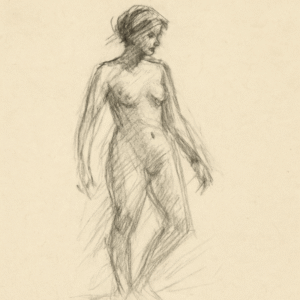
Croquis is a fun and challenging way to express yourself artistically, but for many people, getting started can be intimidating. Here you’ll find a short “course” in croquis drawing for inspiration. You can, of course, paint or draw your partner, children, or others, but you should treat yourself to the experience of working with a professional croquis model. They know exactly how to pose to make your drawing session an interesting artistic challenge.
What Is Croquis?
Croquis is an art form that involves quick, sketch-like drawings of nude models, usually created within a limited time frame. The goal of croquis is to capture the model’s movement, proportions, and expression in a spontaneous and expressive way.
The word croquis comes from French and means “sketch” or “outline.” Croquis drawings are typically made with quick, loose strokes and minimal detail. The focus is on capturing gesture and movement rather than creating detailed portraits.
Learn Croquis Drawing
Here’s a short guide to help you understand the purpose and mindset behind drawing the human figure.
Focus on basic shapes: Start by sketching the basic forms of the model—circles, lines, and simple shapes—to build the underlying structure of the body. This helps establish proportions and the placement of body parts.
Work quickly: Croquis drawing is meant to be fast-paced. Set a time limit for each sketch—typically 1–5 minutes. This helps you capture movement and gesture rather than getting stuck on details. The quick work itself is the real exercise and the reason every artist should practice croquis.
Use loose, expressive lines: Let your strokes be free and dynamic. This helps capture the energy of the pose and makes your drawings more alive. You can start with a hard pencil that leaves light marks, then switch to a softer pencil to strengthen the composition.
Practice proportions: Train your eye to get proportions right by comparing the size of body parts relative to one another and using guiding lines or measurements. You can also study how to work with human proportions and poses in instructional videos. A good way to practice proportions is by looking at the negative space—the shape of the “nothingness” or air between a person’s limbs, torso, or surroundings. Try squinting your eyes slightly to blur the details so you can focus on this negative space.
Focus on gesture: Try to capture the gesture or essence of the model’s movement in your drawings. Focus on the main lines and flow of motion rather than small details.
Use different media: Experiment with different drawing tools such as pencil, charcoal, ink, or watercolor. Each medium has its own qualities that can affect your line, texture, and energy.
Practice regularly: Croquis drawing requires practice like any other form of art. The more you draw, the better you’ll become at capturing movement and expression.
Don’t be afraid of mistakes: Croquis is about capturing the moment and the motion—it’s perfectly fine to make mistakes. Avoid being too perfectionistic, as that can block your creativity and flow. Often, when you revisit your old croquis sketches later, you’ll discover they stand as independent artworks you didn’t notice at the time.
Take classes or workshops: If possible, attend croquis drawing classes or workshops where you can receive guidance and feedback from experienced artists.


