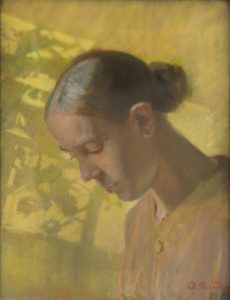

Erik Henningsen was one of the most prominent representatives of social realism in Danish art at the end of the 19th and the beginning of the 20th century. Trained at the Royal Danish Academy of Fine Arts from 1873 to 1877, he became an early advocate for the realist movement, which aimed to depict reality without embellishment. His art centered on the social issues that characterized Copenhagen at the time. With a precise, almost photographic painting technique, Henningsen gave voice to society’s marginalized—workers, women, the unemployed, and the elderly. He portrayed these people not just as victims but as part of a broader social reality, making his works both artistic and political statements.
One of his most famous works, The Guard Parade (1888), demonstrates military precision and order, yet it is more neutral in tone compared to much of his later work. By contrast, Evicted (1892) reveals the harsh realities of a family forced out of their home — a powerful symbol of the social injustice faced by the poor and working class in late 19th-century Denmark. Another work, An Injured Worker (1895), intensifies this social critique by portraying a laborer hurt on the job, highlighting unsafe working conditions and the vulnerability of industrial workers.
Henningsen’s realism made him a master of everyday detail. He was equally adept at capturing the bustle of Copenhagen’s city life and the stark reality of its social inequalities. His paintings serve as historical records of a society undergoing rapid change and modernization.
In addition to painting, Henningsen contributed to Danish culture through illustration. He created drawings for magazines such as Ude og Hjemme and illustrated Johan Krohn’s beloved children’s book Peter’s Christmas in 1914. One of his most iconic works, however, is the famous Tuborg Beer Poster (1900), designed for the brewery’s 25th anniversary. Depicting a sweating, jovial man enjoying a beer, it became an enduring part of Danish visual culture — still used on Tuborg’s labels today. Although it did not win first prize in the original competition, the image became far more popular than the winning entry and remains a classic.
In 1890, Henningsen received the prestigious Eckersberg Medal, recognizing both his technical mastery and his deep commitment to addressing the social and humanitarian issues of his time. His art stands as a lasting testament to an era in Danish history when art was a means of enlightenment and social commentary.
Brief Analysis of a Social Realist Painting by Erik Henningsen
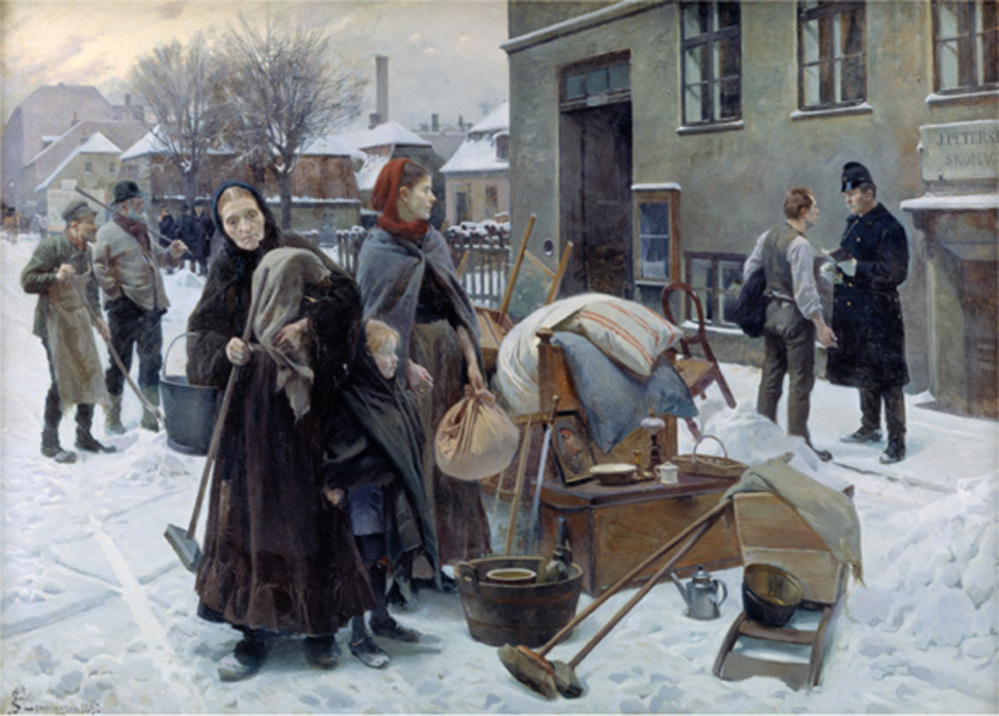
Evicted (1892) – Erik Henningsen
Analysis of “Evicted”
1. When was “Evicted” painted?
The painting was completed in 1892.
2. What does “Evicted” depict?
The painting shows a family being forced out of their home, likely due to unpaid rent. The focus is on the emotional turmoil — sorrow, frustration, and despair — as they stand among their belongings on the street. The man appears to be negotiating with a police officer, while the pregnant woman sits beside their young daughter, embodying both vulnerability and resilience.
3. What are the main themes of “Evicted”?
The themes include poverty, social injustice, and human suffering. Henningsen portrays the family’s distress but also their dignity and strength in the face of hardship. The work reflects a broader social critique — the individual’s struggle against systemic inequality, a hallmark of social realism.
4. Where can the painting be seen?
The painting is part of the collection at the National Gallery of Denmark (Statens Museum for Kunst).
5. What art style does “Evicted” belong to?
The work belongs to realism, a movement that sought to depict the world truthfully, focusing on ordinary people and their struggles. Henningsen’s detailed expressions and lifelike settings emphasize the family’s humanity and the harsh realities of urban life, free from romanticized interpretation.
6. What emotions and symbolism are present in the painting?
Henningsen uses color and symbolism to convey emotion:
- Orange on the pillow suggests frustration and tension.
- Blue in the girl’s dress symbolizes sadness and calmness.
- Green in the father’s jacket conveys hope and endurance.
- Red in the mother’s bonnet stands for love and anger.
- Black worn by the older woman and the officer denotes sorrow and gravity.
These color choices strengthen the painting’s emotional impact, illustrating both despair and human resilience.