
Caja Margrethe Prytz was born on November 27, 1877, in Frederiksberg, Denmark, as the daughter of Colonel Emmanuel Prytz and Christine Margrethe Steenstrup. She died on December 14, 1916, in Copenhagen. Although her life and career were brief, she belongs among the interesting Danish painters of the early 20th century, especially for her quiet interiors, portraits, landscapes, and religious works.
The painting illustrating this article is Interior with Mother and Daughter by the Window (1905).
Education and Artistic Background
Prytz received her early artistic training from Julius Paulsen from 1896 to 1898 and from Otto Haslund from 1898 to 1900. Both were important figures in Danish painting at the time, and their influence gave her a strong foundation in drawing, composition, and realistic observation.
In 1904, she travelled to Paris, where she studied under Lucien Simon and Jacques-Émile Blanche at the Académie de La Palette. The Parisian art scene exposed her to newer European currents, while her Danish training continued to shape her careful attention to form, atmosphere, and light.
She exhibited at the Charlottenborg Spring Exhibition from 1903, which was one of the most important platforms for Danish artists. For a woman artist working around 1900, public exhibition and professional recognition were still not matters of course. Prytz therefore belongs to a generation of women who helped expand the visible role of female artists in Danish art.
What Made Her Interesting in Her Time?
At the beginning of the 20th century, Danish art stood between older naturalist traditions and newer international movements. Caja Prytz worked within this transition. Her paintings do not reject realism, but they soften it with an interest in mood, interior life, and the quiet presence of light.
Her work is especially interesting because it avoids theatrical effects. Instead of dramatic scenes or strong colour contrasts, she often chose calm motifs: a figure by a window, a child in a sunlit room, a landscape seen through a sensitive eye. This gives her paintings a restrained, intimate quality that connects her to the broader Nordic interest in light, home, and atmosphere.
Style and Artistic Expression
Caja Prytz’s paintings can be placed between classical realism and early modern painting. Her style is characterized by muted colours, balanced compositions, and a gentle sensitivity to light. She was not an artist of excess or spectacle. Her strength lies in quiet concentration.
In her interiors, light often becomes the central element. It falls across walls, windows, furniture, and figures in a way that gives the scene emotional depth without becoming sentimental. Her portraits share the same restraint. They are not merely likenesses, but studies of presence, character, and mood.
Her landscapes are also marked by calm observation. Rather than presenting nature as grand or dramatic, she painted it with a lyrical sense of colour and atmosphere. This makes her work feel both rooted in Danish painting tradition and open to the more modern sensibility she encountered abroad.
Motifs and Themes in Caja Prytz’s Work
Caja Prytz worked with several motifs, including portraits, interiors, landscapes, and religious subjects. Across these different genres, her paintings are held together by a clear interest in light, stillness, and human presence.
Portraits
Prytz’s portraits often show a reflective and serious mood. She was interested not only in physical appearance, but also in the sitter’s inner life. Her female portraits in particular have a quiet psychological depth, created through expression, posture, and subtle use of light.
Interiors
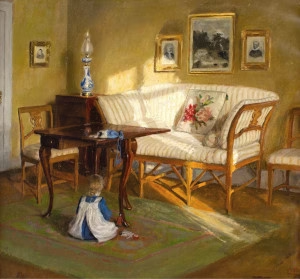
Her interior paintings are among her most compelling works. Girl Playing in Sunlit Interior from around 1904 shows a child playing on the floor in a room filled with warm light. The subject is simple, but the atmosphere is carefully constructed. The painting presents domestic life as something calm, attentive, and visually beautiful.
In these interiors, Prytz combines classical composition with a more modern interest in everyday life. The room is not just a background. It becomes part of the emotional structure of the painting.
Landscapes
Caja Prytz painted landscapes from Denmark and abroad, including Italy. Her landscapes are usually quiet rather than monumental. They show nature through a subdued palette and a sensitive understanding of form, colour, and changing light.
Her Danish landscapes reflect seasonal atmosphere and the rhythm of nature. The compositions are controlled, but never rigid. Her Italian subjects often appear lighter and more sun-filled, yet they remain restrained in tone. In both cases, landscape becomes a space for mood and reflection.
Religious Works
Prytz also worked with religious subjects. Among her known church works are Jesus Heals a Sick Person from 1906, made for Hou Church, and The Return of the Prodigal Son from 1910–11, made for Sjørring Church.
These works show the same human and restrained quality found in her portraits and interiors. Rather than emphasizing grandeur or dramatic religious symbolism, Prytz approached biblical scenes with tenderness, simplicity, and emotional presence.
Exhibitions and Recognition
Although Caja Prytz died young, she exhibited several times during her career. She participated in the Charlottenborg Spring Exhibition, an important institution in Danish art life, and her works were also shown in other exhibition contexts.
Today, she is not among the most widely known Danish painters of her period, but her work remains valuable for understanding the quieter and more intimate side of Danish painting around 1900. Her portrait The Author Miss Christine Daugaard from 1906 is held by Ribe Kunstmuseum, which helps preserve her place in Danish art history.
Caja Prytz and Her Time
Caja Prytz belonged to a generation of Danish artists working at a moment of transition. Danish painting was still shaped by realism and naturalism, but new ideas about colour, light, psychology, and everyday life were gaining ground.
Her art reflects this balance. She did not abandon tradition, but she gave traditional motifs a quieter and more inward-looking expression. In this sense, her work helps show how Danish art around 1900 was not only changing through radical movements, but also through subtle shifts in mood, subject, and atmosphere.
Caja Prytz and Anna Ancher
Caja Prytz and Anna Ancher were both Danish women artists active around the turn of the 20th century. Anna Ancher was older and far more established, but the two artists can still be compared through their shared interest in light, interiors, and quiet domestic scenes.
Anna Ancher, one of the central Skagen painters, is famous for interiors where sunlight becomes almost an active presence in the room. Her paintings often show how light transforms everyday spaces and gives them emotional intensity.
Caja Prytz also used light as a mood-creating element, but her expression is generally more subdued. Where Ancher’s light can be strong and brilliant, Prytz often works with a softer and more restrained atmosphere. Both artists, however, show how interior scenes could become serious artistic subjects, not merely private or decorative motifs.
The comparison also points to the broader role of women artists in Danish art around 1900. Both worked in a period when female artists still had to claim space in a professional art world largely shaped by men. Their paintings show technical skill, artistic independence, and a strong sensitivity to the emotional possibilities of everyday life.
FAQ About Caja Prytz
Who was Caja Prytz?
Caja Prytz, 1877–1916, was a Danish painter known for portraits, interiors, landscapes, and religious works. She was active in Denmark around the beginning of the 20th century.
What did Caja Prytz paint?
She painted portraits, interiors, landscapes from Denmark and abroad, and religious subjects. Her works are especially known for their calm atmosphere and sensitive treatment of light.
What characterizes Caja Prytz’s style?
Her style combines classical realism with a softer, more atmospheric approach. Muted colours, quiet compositions, and psychological presence are central features of her work.
Was Caja Prytz married or did she have children?
There is no widely available documentation indicating that Caja Prytz was married or had children.
Who were Caja Prytz’s parents?
She was the daughter of Colonel Emmanuel Prytz and Christine Margrethe Steenstrup.
Did Caja Prytz exhibit her work publicly?
Yes. She exhibited at the Charlottenborg Spring Exhibition and took part in Danish art life during her relatively short career.