Land Art, also known as Earth Art or site-specific art, represents a unique art form in which nature plays a central role—either as part of the artwork itself or as its backdrop. Originally emerging in the United States in the late 1960s and early 1970s, this genre sits at the boundary between sculpture and landscape architecture. A defining feature of Land Art is that the works are often not intended to be maintained but instead exposed to the forces of nature and allowed to change over time.
Land Art in the United States
Land Art originated in the United States during the late 1960s as a reaction against the commercialization of art and the limitations of traditional gallery spaces. Artists sought to move their practice out into nature, using the landscape itself as both medium and setting. Among the pioneering figures were Robert Smithson, Nancy Holt, Michael Heizer, and Walter De Maria, whose monumental works redefined the boundaries of contemporary art.
Land Art by Robert Smithson
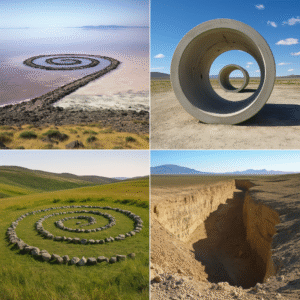
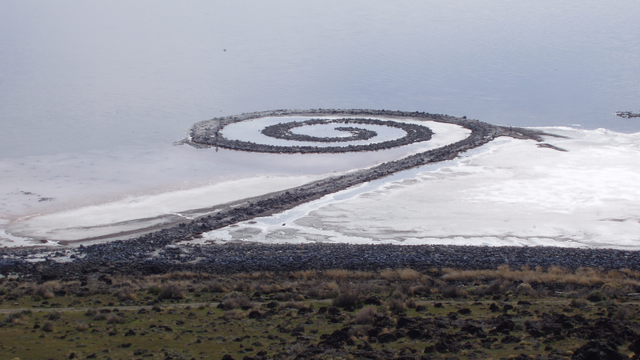
One of the most iconic examples is Robert Smithson’s Spiral Jetty (1970), a massive spiral of basalt rock extending into the Great Salt Lake in Utah. The piece interacts directly with the changing water levels and salinity, making it an evolving artwork shaped by natural processes. Similarly, Michael Heizer’s Double Negative (1969) in Nevada consists of two enormous trenches carved into the edge of the Mormon Mesa, emphasizing absence and displacement as artistic gestures. Nancy Holt’s Sun Tunnels (1973–76) aligns large concrete cylinders with the solstices, creating a poetic dialogue between sculpture and the movement of the sun.
These early projects established Land Art as both an artistic and philosophical exploration—an invitation to engage with the vastness of the American landscape and to reflect on humanity’s relationship with the natural world.
Land Art in Denmark
In Denmark, Land Art has also left its mark. A notable project from 1988 is Krakamarken, located southeast of Randers near Brusgaard, a farm that since 2000 has housed the Scandinavian Design College. Krakamarken functioned as a public sculpture park and stood as an example of how art and nature can be united in the most beautiful way.
Another example of Land Art in Denmark is a roundabout in Jammerbugt Municipality, which since 2004 has been adorned with a sculpture set in a rolling green landscape by the artist Kurt Tegtmeier. This sculpture highlights the dynamic interplay between human-made art and the surrounding nature.
Land Art creates a unique space for reflection and contemplation, allowing people to experience nature in a new and inspiring way. Through these site-specific artworks, we are invited to reconsider our relationship with the environment and to appreciate the beauty inherent in nature’s own creative power.
What techniques are used in Land Art?
Land Art embraces a wide range of techniques, all aiming to manipulate and integrate natural elements to create artworks. Here are some of the most common techniques used in Land Art:
- Terrain modeling: Artists shape and manipulate the landscape by moving earth, stones, and other natural materials to create forms, patterns, and structures directly in the terrain.
- Plant installations: This involves planting vegetation in specific patterns or formations to create visual effects or transform the surrounding landscape.
- Stone arrangements: Artists often use stones to create patterns, labyrinths, circles, or other formations directly on the ground or in water.
- Sculpture: Some Land Art projects include the construction of physical sculptures or structures using natural materials such as stone, wood, or soil.
- Ephemeral materials: Artists may use temporary or changing materials such as leaves, branches, sand, or ice to create artworks that gradually transform or disappear over time.
- Limited resources: An important aspect of Land Art is the use of natural and sustainable materials found locally on site, which can be transformed without leaving lasting traces in nature.
- Photography and video: In addition to the artwork itself, photography and video can also be used to document and communicate Land Art projects to a wider audience.
These techniques can be combined and adapted by the artist depending on the specific site, the intended outcome, and the available resources, resulting in a wide variety of expressions and styles within the Land Art genre.