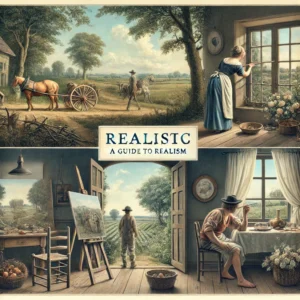
Realism is a fundamentally important attitude and approach—not only within art, but also in philosophy, literature, political science, and other disciplines. Its roots run deep into our understanding of reality and how we interact with it.
Definition of Realism
In art, realism refers to a style or movement that seeks to depict reality in an objective and accurate way, without idealization or excessive romanticism. Realist artworks are characterized by their detailed and precise depictions of objects, people, and landscapes as they actually appear.
The realist approach often involves the use of naturalistic lighting, color, and perspective to create an illusion of depth and authenticity. The goal of realism in art is to reflect observed reality and to evoke a sense of recognition and understanding in the viewer.
The word comes from the Latin realis, meaning “thing, matter, relation,” and it encompasses a wide range of ideas, directions, and schools across philosophy, visual art, literature, and political science.
Realism and Anti-Realism
Realism in Art: A Deeper Understanding
The debate surrounding realism in art extends far beyond a purely technical approach; it addresses fundamental questions about our relationship with reality and how we perceive it. While realism argues that art should represent reality in an objective way, anti-realism challenges this by suggesting that our perception of reality is subjective and relative.
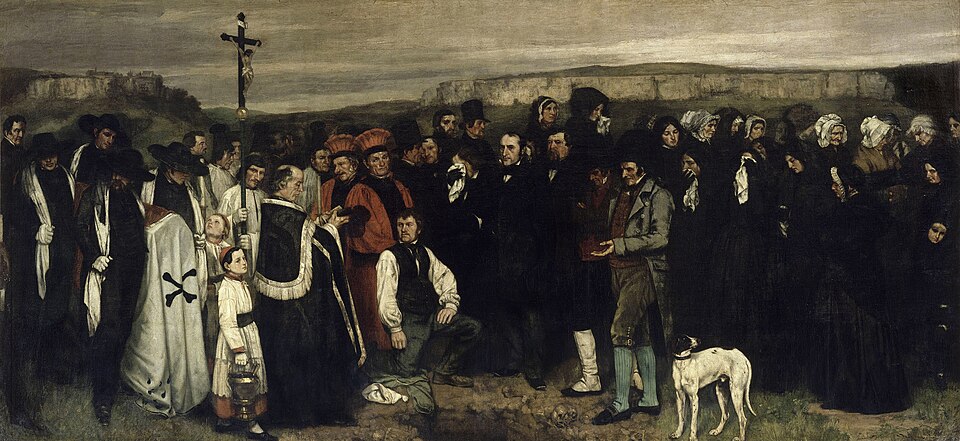
Gustave Courbet – “A Burial at Ornans” (1849–1850)
Examples of Realism in Practice
- Gustave Courbet – “A Burial at Ornans” (1849–1850):
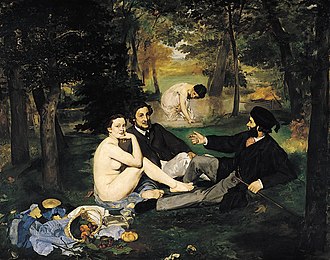
Courbet, one of the leading realist painters, depicted a group of villagers attending a funeral. The painting is remarkable for its precise representation of the human figures and the rural landscape—without idealizing or distorting reality. - Édouard Manet – “Le Déjeuner sur l’herbe” (1862–1863):
This controversial work by Manet challenged the conventions of its time by depicting a picnic scene with clothed men and a nude woman in the open air. Manet employed realist techniques to portray his figures while introducing a modern and anti-conventional approach, turning the painting into a key discussion point about the role of art in society. - Andrew Wyeth – “Christina’s World” (1948):
This iconic American painting shows a young woman, Christina, lying in a field with a house in the distance. Wyeth’s realist style captures every detail of the landscape and the woman’s form, yet it is the emotional depth and underlying symbolism that give the work its particular power and resonance.
These examples illustrate how realism in art is not merely about copying reality, but about communicating complex emotions, ideas, and perspectives through detailed and truthful representation of the world around us.
Categories of Realist Perspectives
Realist perspectives can be classified by the types of practices and entities they concern, as well as the degree to which they affirm those entities’ existence. They include moral conditions, scientific entities, and everyday phenomena, with varying levels of strength in how their existence is perceived.
Realism in Literature
In literature, realism refers to the depiction of reality in a way that readers recognize as plausible and true to life. Since Aristotle, poetry and storytelling have been regarded as forms of mimesis—the representation of reality—demonstrating literature’s realist dimension.
Realism in the Visual Arts
In painting, realism serves both as a general term for artistic depictions of reality without embellishment and as a specific movement within 19th-century European art. The realist movement aimed to accurately portray objects, people, and landscapes, free from the distortions of romanticism.
The Realist School in Political Science
In political science, the realist school focuses primarily on international relations, where power and national interests are considered decisive factors. This approach dates back to the historian Thucydides and the philosopher Machiavelli, emphasizing conflict and war as inevitable aspects of relations between states.
Realism in art is a style that seeks to depict subjects truthfully, without idealization or exaggeration. It focuses on accurate details, natural lighting, and lifelike representation.
The realism movement began in the mid-19th century, led by artists like Gustave Courbet, who wanted to portray everyday life and people as they truly were.
The main goal of realism is to reflect the world as it appears, creating a sense of authenticity and recognition in the viewer.
Romanticism focuses on emotion, imagination, and idealization, while realism aims to depict the ordinary world accurately and objectively.
Notable realist artists include Gustave Courbet, Édouard Manet, and Andrew Wyeth, all known for their detailed and emotionally powerful works.