
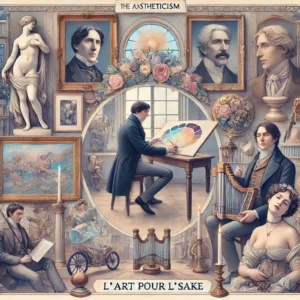
Aestheticism was an artistic and literary movement that emerged in the 19th century as a response to the Industrial Revolution and society’s growing focus on material value and utility. It was defined by its celebration of beauty, aesthetics, and the sublime as central principles in both art and life.
Definition of Aestheticism
Aestheticism emphasized the importance of form, color, and harmony in art and literature. It also focused on the personal and subjective experience of beauty, valuing individual expression over conformity to moral or social conventions.
The term aestheticism comes from the word <a href=”https://artschool.nu/aestetik/”>aesthetic</a>, which originates from the Greek aisthesis, meaning sensation or perception.
The History of Aestheticism
The movement arose as a counterreaction to an increasingly industrialized and pragmatic world. Artists and writers such as Oscar Wilde, James McNeill Whistler, and Walter Pater argued that art should exist independently of moral or political concerns, aiming instead to create beauty for its own sake. Critics, however, accused the movement of being indifferent to social and political issues and of prioritizing surface beauty over meaning and depth.
Background and Origins
Aestheticism grew out of dissatisfaction with the materialism of Victorian society. Many artists and thinkers believed that the focus on economic progress had overshadowed the value of beauty and aesthetic experience.
Core Principles
- The Primacy of Beauty: Beauty was regarded as the ultimate purpose of both art and life. Art should be appreciated purely for its aesthetic qualities, without any moral or political agenda.
- L’art pour l’art: The French phrase “art for art’s sake” became the central motto of aestheticism, emphasizing artistic freedom and the idea that art needed no justification beyond its own beauty.
- Sensitivity and Aesthetic Pleasure: The movement encouraged an appreciation of refinement, harmony, and sensual delight in all aspects of life—from art and literature to nature and everyday experience.
Key Figures
Among the most influential figures of aestheticism were:
- Oscar Wilde: The Irish writer who championed beauty and art’s independence in works such as The Picture of Dorian Gray and The Decay of Lying.
- James McNeill Whistler: The American painter whose works, including Arrangement in Grey and Black No. 1 (Whistler’s Mother), celebrated the elegance of simple form and subtle color.
Aestheticism in Art and Literature
In visual art, aestheticism found expression through painting, sculpture, and design. Artists explored color, form, and composition to create works that appealed to the senses and evoked emotion. In literature, writers cultivated a refined and sensuous style, focusing on beauty of language and expression.
Modern Legacy and Influence
Although aestheticism reached its peak in the 19th century, its influence continues to shape modern art and culture. Many contemporary artists and writers still celebrate beauty and the sublime as essential to creative expression. The movement remains a reminder of the value of appreciating and cultivating beauty in an increasingly utilitarian world.
A Celebration of Beauty and Expression
Aestheticism endures as a tribute to the form and purpose of beauty in both art and life. Its devotion to aesthetic quality and the personal experience of beauty has enriched art and literature alike, inspiring new generations of artists and writers to explore the infinite possibilities of the beautiful.
FAQ: Aestheticism
Aestheticism was an artistic and literary movement in the 19th century that celebrated beauty, art, and sensory experience as central to life. It rejected moral or political functions of art, focusing instead on creating beauty for its own sake.
Key figures included Oscar Wilde, James McNeill Whistler, and Walter Pater. They each emphasized art’s independence and the importance of beauty and artistic refinement.
In art, aestheticism led to experimentation with form, color, and composition to evoke sensory pleasure. In literature, writers focused on elegant language and style, celebrating beauty and emotional depth.
Yes. Although the movement peaked in the 19th century, its focus on beauty, individuality, and sensory experience continues to inspire contemporary artists, writers, and designers.