Jeffrey Lynn Koons is an American contemporary artist recognized for his work with popular culture and his sculptures depicting everyday objects, including balloon animals, crafted in stainless steel with mirror-like surfaces. He resides and works in both New York City and his hometown, York, Pennsylvania. His artworks have been sold for substantial amounts, including at least two record auction prices for a work by a living artist: $58.4 million for “Balloon Dog (Orange)” in 2013 and $91.1 million for “Rabbit” in 2019.
Jeff Koons Biography
Jeff Koons was born on January 21, 1955, in York, Pennsylvania. His father was a furniture dealer and interior designer, while his mother was a seamstress. At the age of nine, his father displayed old masterpieces in his shop window, which Koons copied and signed in an attempt to attract visitors. As a child, he sold wrapping paper and candy door-to-door after school. As a teenager, he admired Salvador Dalí so much that he visited him at the St. Regis Hotel in New York City.
Koons began his career in the 1970s and achieved breakthrough success in the 1980s with the series “The New” and “Equilibrium.” He is known for using industrial materials such as stainless steel, porcelain, and plastic to create his artworks. His work often features a polished and smooth surface, creating a blend of kitsch and glamour.
Koons studied painting at the Maryland Institute College of Art in Baltimore and at the School of the Art Institute of Chicago. While a student at the Art Institute, Koons met artist Ed Paschke, who became a significant influence and whom Koons worked as a studio assistant for in the late 1970s. After completing his education, Koons moved to New York in 1977 and worked at the membership desk of the Museum of Modern Art, concurrently establishing himself as an artist.
Jeff Koons’ Major Breakthrough came in the mid-1980s as part of an artist generation exploring art’s significance in a media-saturated era. He gained recognition in the 1980s and subsequently established a factory-like artist studio in a loft in the SoHo district on the corner of Houston Street and Broadway in New York. The studio was staffed with over 30 assistants, each responsible for different aspects of his work – similar to Andy Warhol’s Factory. Koons’ works were produced using a method known as art fabrication. Until 2019, Koons had a 1500 m2 studio near the old Hudson rail yards in Chelsea and employed between 90 and 120 assistants to produce his works. Recently, Koons has reduced his staff and transitioned to more automated production methods, moving to a much smaller studio space. Koons employed a paint-by-numbers system, allowing each of his assistants to execute his canvases and sculptures as if made “by one hand.”
Jeff Koons’ Art
Koons’ work has been both admired and criticized. Some see him as a brilliant artist challenging the boundaries of art, while others view his works as superficial and commercial. His artworks have achieved record prices at auctions and have been exhibited in museums and galleries worldwide.
Jeff Koons’ work spans several different series and themes. He has worked with inflatable objects like balloon animals and has also explored conceptual sculpture, advertising, and alcohol-related motifs. Some of his most famous works include sculptures like Rabbit, Balloon Dog, and Puppy.
Some of Koons’ most famous works include the “Balloon Dog” series, where he creates giant sculptures of balloon animals in various colors. He is also known for works like “Rabbit,” “Puppy,” and “Michael Jackson and Bubbles.” Many of his artworks explore themes of idolization, consumerism, pop culture, and kitsch. Works like Rabbit and Balloon Dog have been sold for record prices and exhibited in museums and galleries worldwide.
Koons’ work has sparked debate and discussion within the art world, making him one of the most prominent and controversial contemporary artists of our time.
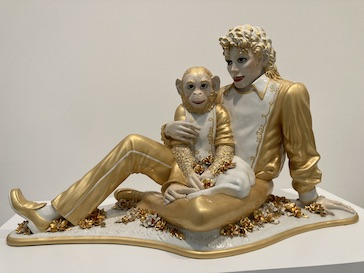
Michael Jackson and Bubbles
“Michael Jackson and Bubbles” is a sculpture created by Jeff Koons. This sculpture was made in 1988 and depicts the famous pop star Michael Jackson alongside his pet chimpanzee named Bubbles. The sculpture is part of Koons’ series called “Banality,” in which he portrays ordinary objects and figures from popular culture.
The sculpture is made of porcelain and is hand-painted to achieve a realistic effect. It shows Michael Jackson wearing a blue jacket with gold embellishments and standing with his arms around Bubbles. The figure of Bubbles is dressed in a white shirt and sits on a pedestal next to Jackson.
“Michael Jackson and Bubbles” has been the subject of discussion and debate. Some view the sculpture as a tribute to the famous musician and a symbol of pop culture iconography. Others believe it’s an example of Koons’ fascination with celebrity culture and his critique of consumer culture.