Apelles is one of the best-documented painters of ancient Greece, even though none of his works have survived. Our knowledge of him comes primarily from ancient authors such as Pliny the Elder and from later biographical traditions. Across these sources, he appears as a key reference for technical mastery, portraiture, and theoretical reflection on the principles of painting – qualities that made him a benchmark for centuries.
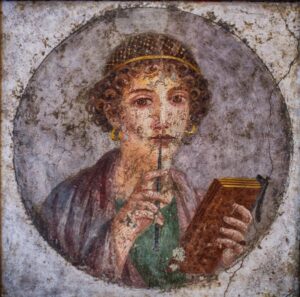
The image for this article is a portrait fresco from Pompeii, showing a young woman with a stylus and wax tablet; an example of Roman wall painting that illustrates the pictorial tradition contemporary with Apelles.
Historical context and biographical outline
Apelles is believed to have been born on the island of Kos in the 4th century BCE. He was trained in Sikyon, one of the most important artistic centres of the period. Here he received thorough technical and theoretical instruction, particularly under Pamphilos, who emphasised drawing, proportion, and artistic theory.
His career took shape when he became associated with the Macedonian court under Philip II and later served as official portrait painter to Alexander the Great. It was in this environment that his reputation for precision and psychological insight was formed.
Apelles’ technique and artistic practice
Although the descriptions are fragmentary, they point to several aspects that made Apelles remarkable:
The glaze technique (atramentum)
Pliny describes a dark, transparent varnish that Apelles applied over finished paintings. It unified the tonal range, softened the harshness of the colours, and created optical depth. The technique is often compared to later glazing methods, even if the exact material may have been different.
Light–dark contrasts
Apelles’ command of contrasts – not as full chiaroscuro in the later Italian sense, but as a refined sense of plastic modelling – is frequently emphasised in the sources.
Portraiture
Ancient writers stress his ability to capture both likeness and character. This suggests that he worked with a synthesis of idealised features and individualised details, a balance later artists took up in Hellenistic and Roman portrait traditions.
Compositional simplification
Apelles was praised for his ability to select what was essential and leave out what was superfluous. This principle is often highlighted in ancient art theory and points to a conscious aesthetic discipline.
Anecdotes as sources for ancient views on art
Antiquity preserved several anecdotes about Apelles, and even though they are not necessarily historically reliable, they clarify contemporary ideals for the role of the artist.
Aphrodite Anadyomene
The most famous work attributed to him is a depiction of Aphrodite rising from the sea. In antiquity it was celebrated for its elegant execution, and later it served as an iconographic model in both the Renaissance and the 19th-century Neoclassicism.
“Cobbler, stick to your last!”
The anecdote about the cobbler who criticised a sandal in one of his works, and was later corrected, has become part of European cultural heritage. In an art-historical context, the story shows how specialised knowledge and powers of observation were valued – and at the same time how sharply one distinguished between legitimate and illegitimate criticism.
The meeting with Protogenes
The rivalry between Apelles and Protogenes – especially the story about the extremely fine lines they left on a panel – is often used as an image of the technical perfection ancient artists strove for. It also illustrates an artistic culture in which skill was evaluated as a form of intellectual competition.
Afterlife and reception
Although his works have not been preserved, Apelles had enormous influence in the Renaissance and beyond. Artists such as Botticelli, Dürer and Leonardo da Vinci knew his name from ancient texts and used the accounts of him as a benchmark for technical mastery and artistic seriousness.
In modern art-historical research, Apelles functions as an important example of how ancient art was understood, discussed, and idealised – not only as craft, but as an intellectual discipline.
Comparison with other ancient painters
| Painter | Period | Characteristics | Known for |
|---|---|---|---|
| Apelles | 4th c. BCE | Portraiture, mythology | Glaze technique, psychological realism |
| Zeuxis | 5th c. BCE | Illusionism | Naturalistic rendering (the famous grapes) |
| Parrhasius | 5th c. BCE | Figurative painting | Illusionistic curtain |
| Protogenes | 4th c. BCE | Extreme detail | Rivalry with Apelles |
This table shows the differences in method and aesthetics that the ancient art-theoretical tradition itself highlighted.
Art theory and the philosophical dimension
Apelles appears frequently in discussions of the purpose of art. His search for precision, his attentiveness to criticism, and his ability to balance idealisation and realism place him in a tradition in which art is understood as both a technical discipline and a form of inquiry.
The anecdotes about him provide insight into ancient expectations regarding the artist: technical skill, sound judgement, and ethical-professional responsibility.
Key points in brief
| Aspect | Description |
|---|---|
| Period | 4th century BCE |
| Place of birth | Kos, Greece |
| Role | Court painter to Alexander the Great |
| Technique | Glaze (atramentum), contrast, compositional clarity |
| Central works | Aphrodite Anadyomene (lost) |
| Legacy | Model figure for the Renaissance understanding of art |
Apelles in a broader art-historical perspective
Apelles’ legacy does not rest on his physical works, but on the way he was described and remembered in antiquity. This makes him a key figure for questions about how art history is written when the material is fragmentary. His name functions as a symbolic centre for the entire discussion of technique, the role of the artist, and aesthetic ideals in the classical tradition.