
This period encompasses artworks from the ancient civilizations of Egypt, Mesopotamia, Greece, and Rome. Ancient Greek art is characterized by idealized sculptures, realistic paintings, and architecture featuring classical columns and temple facades.
What Is Ancient Art?
Ancient art refers to the artistic creations of early civilizations and cultures that existed before the modern era. Although the exact timeframe varies depending on geography and cultural context, ancient art generally spans the long period before the Middle Ages.
It includes:
- Prehistoric art – cave paintings, stone carvings, clay figurines, and early ritual objects created before the invention of writing.
- The great ancient civilizations – Egypt, Mesopotamia, the Indus Valley, China, Greece, Rome, Persia, the Maya and many more, roughly from 3000 BCE to the 5th century CE.
- Late antiquity and early medieval traditions – in some definitions, ancient art also overlaps with the transitional period from the fall of Rome to the early Middle Ages, when classical artistic traditions continued.
Ancient art spans an enormous range of media, including painting, sculpture, pottery, jewelry, textiles, architecture, metalwork, relief carving, and monumental structures.
What is Antiquity?
Antiquity refers to a period in history spanning from the 8th century BC to the 6th century AD. This era was marked by significant cultural and intellectual activity in the civilizations of the Mediterranean region, including the ancient Greek and Roman civilizations.
The Greek ancient period is known for its great philosophers such as Socrates, Plato, and Aristotle, as well as its art, architecture, and literature. The Greeks established democratic political systems, developed important scientific and mathematical theories, and created epic literary works like Homer’s Iliad and Odyssey.
The Roman ancient period built upon the Greek legacy and established a vast empire spanning large parts of Europe, the Middle East, and North Africa. The Romans were skilled engineers and created impressive structures like the Colosseum, Pantheon, and aqueducts. Roman legal systems and political institutions also had a significant impact on Western civilization.
Antiquity also saw significant advancements in science, philosophy, art, and literature. This period was known for a humanistic approach, considering humans as the measure of all things. The civilizations of antiquity left a legacy of ideas, values, and artistic expressions that continue to influence our modern world.
It’s important to note that the concept of “antiquity” covers a broad period and varied cultural expressions depending on the geographical area. There are many different perspectives on antiquity, and scholars continue to investigate and explore this fascinating period in history.
Ancient Art
Ancient art is a significant period in art history that spans from around 3000 BC to 300 AD. It includes artworks created in various ancient civilizations, including Egypt, Mesopotamia, Greece, and Rome. Ancient Greek art is particularly notable for its influence and lasting significance.
In ancient Egypt, art focused on preserving and depicting divine and royal figures. Egyptian art is known for its monumental and hierarchical sculptures, such as sphinxes, obelisks, and statues of pharaohs. They were also skilled in creating relief art and painting murals on the walls of tombs.
In Mesopotamia, which encompassed city-states like Sumer, Babylon, and Assyria, art was primarily used for religious and political purposes. They developed cuneiform script, and their art featured monumental palaces and ziggurats, which were terraced temples. Their sculptures and reliefs often depicted mythological and royal motifs.
Greece is famous for its unique artistic practices and aesthetics. Classical Greek art, flourishing from the 5th to the 4th century BC, focused on human beauty and ideals. The Greeks created realistic and idealized sculptures of gods, heroes, and humans. They also produced intricate paintings on ceramics and murals. The architecture of ancient Greece is known for its use of classical columns, such as Doric, Ionic, and Corinthian columns, and iconic structures like the Parthenon temple on the Acropolis.
Roman art was heavily influenced by Greek art, and the Romans adopted many Greek stylistic traits. Romans created large and impressive structures like the Colosseum, Roman Forum, and thermal baths. Their sculptures were realistic and portrayed both emperors and common people. Romans also developed the art of painting frescoes and mosaics, which were used to decorate the walls of their homes and public buildings.
Ancient art has had a tremendous influence on subsequent artistic periods and has formed the basis for many artistic principles and techniques. The idealized beauty and realism highlighted in ancient art were admired and emulated in later periods, and its architectural styles and columns were revived in the Renaissance.
Why Ancient Art Matters
Ancient art is not merely decorative; it is a key to understanding early societies. It reveals how people lived, what they believed, how they structured power, and how they imagined the divine. It documents technological innovation, social hierarchy, gender roles, and ideals of beauty. It also represents the individual creativity and skill of artists whose names we often do not know, yet whose work shaped entire cultures.
Through ancient art, we see the origins of many artistic concepts that still define aesthetics today: proportion, symmetry, symbolism, narrative representation, and monumental architecture.
The Diversity of Ancient Art
Ancient art is remarkably diverse, shaped by geography, climate, religion, politics, and cultural traditions.
Egypt
Egyptian art is characterized by monumental architecture, such as pyramids and temples, richly decorated tombs, symbolic colors, strict formal rules, and a deep focus on spirituality and the afterlife.
Mesopotamia
Mesopotamian art includes ziggurats, cylinder seals, relief carvings, metal sculpture, and some of the earliest narrative scenes documenting kingship, warfare, and mythology.
Ancient Greece
Greek art introduced idealized realism, naturalistic sculpture, ceramic painting, architectural orders (Doric, Ionic, Corinthian), and a strong focus on proportion, beauty, and humanism.
Rome
Roman art blended Greek influences with its own traditions. It is known for portraiture, mosaics, monumental architecture (such as aqueducts and amphitheaters), engineering, and realism.
The Indus Valley, Persia, China, and the Americas
Across Asia and the Americas, ancient cultures developed distinct artistic languages—from Chinese bronzes and terracotta armies to Persian palaces, Mayan stelae, and Nazca geoglyphs.
This global variety shows that ancient art is not one unified style but a vast array of cultural expressions across millennia.
Functions and Purposes of Ancient Art
Ancient art served multiple purposes, often simultaneously:
- Religious and ritual roles: honoring gods, mediating with the divine, performing ceremonies.
- Political propaganda: celebrating rulers, displaying power, legitimizing authority.
- Historical record: documenting wars, myths, dynasties, and cultural milestones.
- Social communication: representing ideals of beauty, gender roles, class structure, and moral values.
- Practical and architectural functions: temples, dwellings, monuments, fortifications, ceremonial sites.
In many cultures, art was inseparable from religion, politics, and daily life.
Preservation of Ancient Art
A significant part of ancient art has been lost to time due to erosion, war, looting, and climate change. Preservation is therefore crucial. International organizations and governments work to restore and protect ancient monuments, regulate the art trade, and collaborate on cultural heritage initiatives.
The artworks that survive today represent only a fraction of what once existed, making their protection especially important.
Ancient Times vs. Antiquity – What’s the Difference?
Although the terms are sometimes used interchangeably, they refer to different historical scopes:
Ancient Times
- The broad early period of human history.
- Includes prehistoric societies and the earliest civilizations.
- Covers everything from the first human expression to the rise of classical civilizations.
Antiquity
- A more specific period focused on the classical civilizations of Greece and Rome.
- Known for major contributions to art, philosophy, politics, and science.
- Spans roughly from the 8th century BCE to the fall of the Western Roman Empire in the 5th century CE.
In short:
Ancient times is the broad umbrella for early human history.
Antiquity refers specifically to the classical world of Greece and Rome.
Art from the Antiquity
Examples of art produced in antiquity:
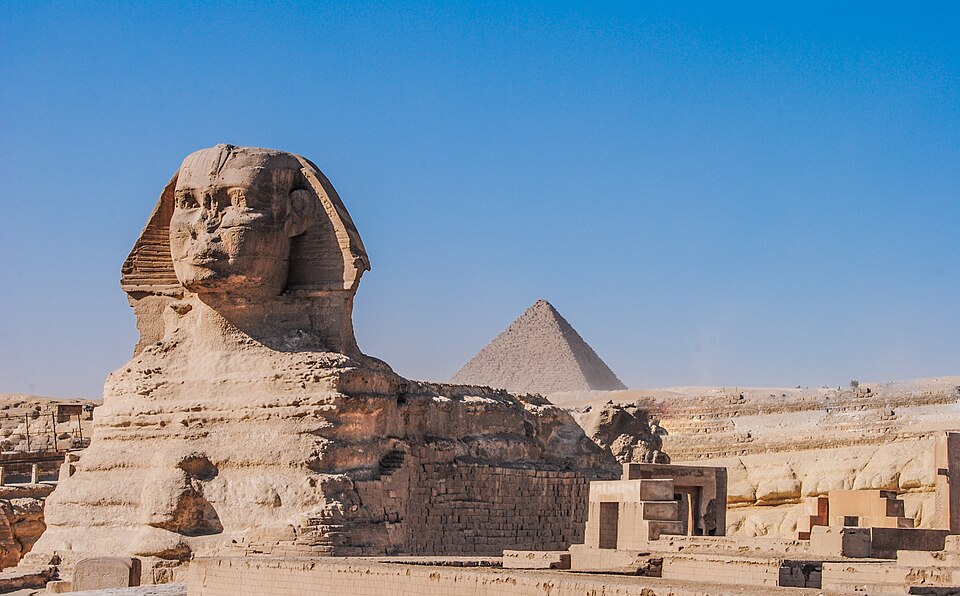
The Egyptian Sphinx: A massive stone statue with a lion’s body and a human face, typically associated with the pharaohs of ancient Egypt. The most famous sphinx is the Great Sphinx on the Giza Plateau outside Cairo.
Image by Hesham Ebaid – Own work, CC0
Parthenon Temple: A classical Greek temple located on the Acropolis in Athens, built between 447 and 438 BC in honor of the goddess Athena. It’s an iconic example of Doric architecture.
Discobolus (Discus Thrower): A famous bronze statue of an athlete throwing a discus. It was created by the Greek sculptor Myron in the 5th century BC.
Venus de Milo: A classical Greek statue depicting the Roman goddess Venus (Aphrodite) and was discovered on the island of Milos in Greece in the 19th century.
Colosseum: Also known as the Flavian Amphitheatre, it’s a massive arena in Rome built in the 70s AD. It was used for gladiatorial games and other public performances.
Terracotta Army of Xi’an: A vast collection of terracotta soldiers and horses buried with the first Chinese emperor, Qin Shi Huang, to protect him in the afterlife. Discovered in 1974, they are part of his mausoleum.
Ancient Greek Vase Painting: Ancient Greeks decorated ceramic vases with intricate paintings illustrating myths, everyday scenes, sports, and war. These vases provide valuable insights into their culture and lifestyle.
Hieroglyphs in Egyptian Tombs: Ancient Egyptians used hieroglyphs, a form of writing with symbols and images, to document stories, religious texts, and inscriptions on the walls of tombs and temples.
These are just a few examples of artworks from antiquity. Countless other incredible artworks were produced during this period.


