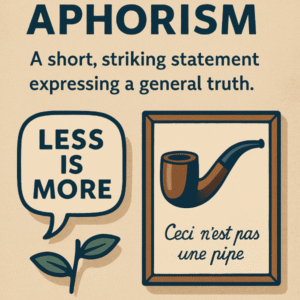
An aphorism is a short and striking sentence that conveys a profound thought or moral truth. It is typically a form of proverb or saying that expresses an idea in a concise and memorable way. Aphorisms are often used to communicate complex ideas or philosophical concepts in an easily digestible form. They can be poetic, humorous, or thought-provoking and are frequently used to emphasize a point or reveal a deeper insight. Famous writers such as Friedrich Nietzsche, Oscar Wilde, and Mark Twain were known for their use of aphorisms in their works.
The word aphorism comes from the Greek aphorismós, meaning “a concise, thought-filled expression” or “a pithy saying.”
Aphorisms in Visual Art
In visual art, aphorisms can often be expressed through visual symbols or textual elements.
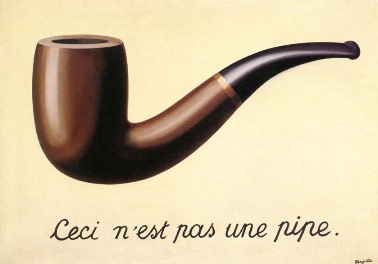
A well-known example is René Magritte’s painting “Ceci n’est pas une pipe” (This is not a pipe).
The work shows a painted image of a pipe with the text “Ceci n’est pas une pipe” written beneath it. It explores the relationship between the image and what it represents.
The painting reminds us that the artwork is only a representation of a pipe, not a real pipe, and it invites us to reflect on the connection between reality and representation in art.
This visual aphorism challenges our perception of reality and the nature of art in a thought-provoking way.