On our free online platform, where we offer lessons in art history, techniques, and materials, we explore the artistic periods that have shaped our visual world. In this article, we dive into Mannerism – a fascinating artistic movement that emerged in Italy in the 1520s and flourished until around 1600. Mannerism marks the transition between the harmonious High Renaissance and the dramatic Baroque, characterized by a distinctive and often surprising aesthetic.
What Is Mannerism?
Mannerism can best be described as an artistic approach that diverged from the Renaissance ideals of balance, proportion, and naturalism. While Renaissance artists sought to depict the world and the human body in perfect harmony, Mannerist artists deliberately broke these conventions.
The term “Mannerism” comes from the Italian “maniera”, meaning “style” or “manner.” Originally, the word was used pejoratively to criticize artists who imitated the great masters – such as Leonardo da Vinci and Michelangelo – without adding originality. Today, however, Mannerism is regarded as a neutral and legitimate term for the period.
Emerging as a reaction to the established norms, Mannerism expressed a new spirit of experimentation. Artists began to explore elongated and distorted figures, unexpected color combinations, and complex compositions. The goal was no longer to reproduce reality faithfully, but to interpret and amplify it through a personal, elegant, and sometimes deliberately artificial style.
The Emergence and Development of Mannerism
The Mannerist period began in the 1520s, primarily in Italy, and lasted until the end of the 16th century. It formed a bridge between the classical Renaissance – exemplified by Leonardo da Vinci and Michelangelo – and the following Baroque period. Mannerism developed alongside the Late Renaissance but gradually departed from its principles.
The Renaissance was marked by a strong belief in human reason and harmony, often inspired by classical ideals. Mannerism, however, arose in a time of political and religious unrest, including the Reformation and the Sack of Rome in 1527. This climate of uncertainty is reflected in the more restless and complex expressions of Mannerist art. The new style quickly spread from Italy to the rest of Europe, where it adopted local variations.

Characteristics of Mannerist Art
Mannerism’s defining features are varied and often challenging. Below are some of the most notable traits you’ll encounter in this period:
- Elongated and distorted figures: The human body is often shown with unnaturally long limbs and graceful but twisted poses, creating a sense of imbalance and movement. This contrasts with the Renaissance ideal of perfect proportion.
- Artificial colors: Instead of naturalistic tones, Mannerist artists used strong, sometimes jarring colors that could appear unnatural and heighten the expressive effect. The goal was not realism, but an aesthetic exaggeration.
- Complex compositions: Mannerist works often feature crowded scenes with figures moving unpredictably, avoiding a clear central focus. This creates tension and visual energy.
- Subjectivity and emotion: Mannerism emphasized the artist’s personal expression and emotional interpretation rather than objective representation. The works can appear mysterious, ambiguous, and open to interpretation.
- Elegance and refinement: Despite their distortions, Mannerist artworks often maintain a sense of sophistication and beauty. Details are meticulously rendered, and there is a fondness for ornamentation and decorative precision.
Together, these characteristics reveal a style that broke with the past and opened the way for greater artistic freedom.
Mannerism in Painting
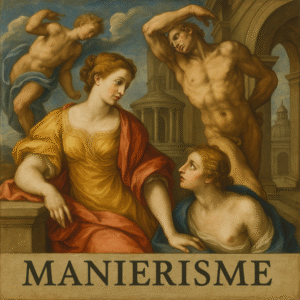
In painting, Mannerism is evident in the works of artists such as Bronzino, Rosso Fiorentino, and Parmigianino. Their paintings often feature slender, elongated figures with small heads and exaggerated elegance. The color palettes can be metallic or unexpected, and the compositions are filled with diagonal lines and unconventional perspectives.
Think of Bronzino’s “Allegory of Venus and Cupid”, with its intricate symbolism and crowded figures, or Parmigianino’s “Madonna with the Long Neck”, an iconic example of Mannerist distortion and beauty. These works stand in sharp contrast to the Renaissance ideal of calm balance and harmony.
Mannerism in Architecture
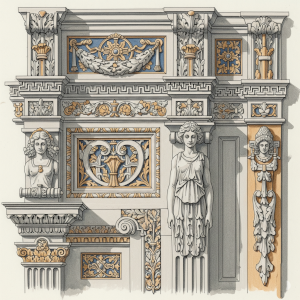
Mannerism also influenced architecture, where classical elements were reinterpreted in playful and unconventional ways. Architects like Giulio Romano and Andrea Palladio experimented with proportions and placement of details. They used columns, pediments, and cornices in unexpected combinations to create surprise and visual tension.
A famous example is Palazzo del Te in Mantua, designed by Giulio Romano, which challenges classical order with its irregular proportions and deliberately “misplaced” masonry.
The Difference Between Renaissance, Mannerism, and Baroque
To fully understand Mannerism, it helps to see its place in art history relative to the surrounding periods:
| Period | Approx. Dates | Main Traits | Focus |
|---|---|---|---|
| Renaissance | 1400–1520 | Harmony, realism, balance | Humanity, nature, antiquity |
| Mannerism | 1520–1600 | Distortion, elegance, complexity | Artist’s subjectivity |
| Baroque | 1600–1750 | Drama, movement, grandeur | Emotion, dynamism, splendor |
While the Renaissance aimed for idealized reality and the Baroque sought emotional power and drama, Mannerism occupied the middle ground with its refined yet unsettling elegance. On our platform, we explore these transitions in our art history courses, helping you understand how styles influence one another.
Key Artists of the Mannerist Period
Mannerism produced many important artists, each contributing in unique ways to the style’s development:
- Parmigianino (1503–1540): Known for his elegant, elongated figures and refined style. His “Madonna with the Long Neck” remains a hallmark of Mannerist art.
- Bronzino (1503–1572): A leading Florentine Mannerist, famous for his formal, cool portraits and allegorical works with luminous color.
- Rosso Fiorentino (1494–1540): One of the earliest Mannerists, recognized for his dramatic, emotional compositions and sharp contrasts.
- Jacopo da Pontormo (1494–1557): His expressive figures and vibrant colors convey mystery and psychological depth, as seen in “The Deposition from the Cross.”
- Tintoretto (1518–1594): Often considered a bridge to the Baroque, his dynamic compositions and dramatic lighting show strong Mannerist elements.
- El Greco (1541–1614): The Greek-born artist working in Spain is perhaps the most famous non-Italian Mannerist, known for his elongated forms and spiritual intensity.
These artists demonstrated how art could express complex emotions and ideas through stylized form and daring imagination.
The Influence and Legacy of Mannerism
Though relatively short-lived, Mannerism had a profound influence on later Baroque art and paved the way for greater artistic freedom. Its emphasis on expression, feeling, and virtuosity can be traced in subsequent movements. Today, Mannerism is recognized not as a “degenerate” version of Renaissance art, but as a vital and innovative period with its own aesthetic value.
Studying Mannerism helps us understand how art evolves through dialogue and reaction. On our online platform, you can explore many other art historical periods and see the connections between them. Our courses cover everything from ancient art to modernism and postmodernism, along with practical lessons in drawing, oil painting, and material science, including color theory. Our goal is to provide you with the tools and knowledge to explore your creativity and deepen your understanding of the art world.
Frequently Asked Questions About Mannerism
Mannerism emerged in the 1520s, primarily in Italy, and lasted until around 1600. It represents the transitional phase between the High Renaissance and the Baroque.
Key features include elongated and distorted figures, unnatural or vivid colors, complex and unbalanced compositions, and an emphasis on elegance and the artist’s subjective expression.
The term comes from the Italian ‘maniera’ (style/manner) and was originally used pejoratively to describe artists who imitated the great masters without originality. Today, it is a neutral term for the period.
Some of the most renowned Mannerist artists include Parmigianino, Bronzino, Rosso Fiorentino, Pontormo, and El Greco. You can learn more about these and other masters in our artist wiki.
The Renaissance focused on harmony and realism, Mannerism on elegance and distortion, and the Baroque on drama and movement. Mannerism sits stylistically and chronologically between the two.