
Rudolf Steiner (1861-1925) was an Austrian philosopher, the founder of anthroposophy and the man behind Waldorf education. To him, color was far more than decoration. He saw each hue as a living force with its own character, able to affect the human soul. His ideas grew directly out of color theory as Goethe had formulated it, and they still shape painting in Waldorf schools, anthroposophic art therapy and the architecture of the Goetheanum in Switzerland.
Image Colors and Lustre Colors
The core of Steiner’s color theory comes from a series of lectures he gave in Dornach in 1921, published as The Nature of Colours (German: Das Wesen der Farben). Here he divided colors into two families based on how they behave, not on whether they feel warm or cool.
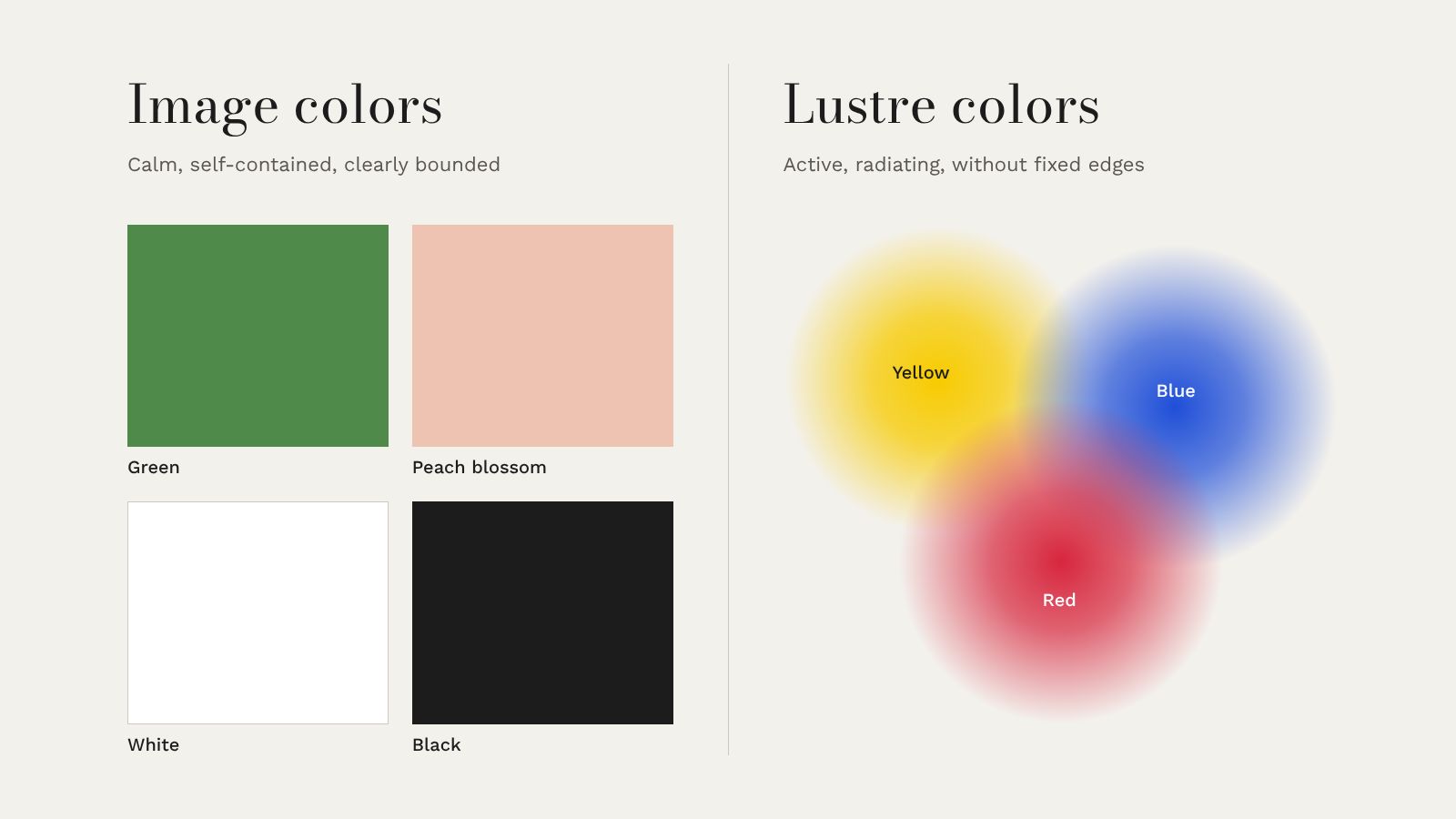
Image colors (Bildfarben) are calm and self-contained. They work like pictures: each one is a still image of something else. Steiner counted four of them:
- Green, which he called the lifeless image of the living, as seen in plants.
- Peach blossom, a soft, warm pink close to the color of human skin, which he described as the living image of the soul.
- White, the soul’s image of the spirit.
- Black, the spiritual image of the lifeless.
Lustre colors (Glanzfarben) are active and radiating. They do not stay within their borders but shine outward. Steiner named three:
- Yellow, the lustre of the spirit. It radiates from its center and wants to spread.
- Blue, the lustre of the soul. It gathers inward and gives a sense of depth.
- Red, the lustre of the living. It holds a balance and fills a surface evenly.
For a painter, this division has a practical consequence. Steiner suggested that image colors work best as flat, clearly bounded areas, while lustre colors should be allowed to flow and fade at the edges. A yellow patch painted with a hard outline, in his view, goes against the nature of the color.
Read more: https://rsarchive.org/Lectures/GA291/English/RSPC1935/19210507p01.html
Inherent Properties of Colors
Steiner argued that every color carries its own gesture: a direction of movement the eye and mind follow. Yellow pushes outward toward the viewer. Blue retreats and creates distance. Red stands still and asserts itself. These qualities are not added by the artist but belong to the colors themselves, which is why he spoke of their inherent properties.
This leads to a different way of painting. Instead of drawing an outline and filling it in, the painter lets forms grow out of the colors. Where yellow meets blue, a green arises. Where red presses against blue, a violet tension appears. The motif emerges from these meetings rather than from a preliminary sketch.
Spiritual Significance of Colors According to Steiner
Because Steiner saw the human being as body, soul and spirit, he linked colors to all three levels. Below is a short overview of how individual hues are commonly described in anthroposophic tradition:
- Red: strength, will and life force. It is connected with the physical body and with the courage to act.
- Orange: warmth and enthusiasm, a bridge between the will of red and the clarity of yellow.
- Yellow: thinking, insight and an open mind turned toward the world.
- Green: rest and balance. Steiner regarded it as the neutral middle between warm and cold.
- Blue: inwardness, longing and devotion. It draws the viewer into reflection.
- Violet: the meeting of red and blue, associated with dignity and the threshold to the spiritual.
- White and black: light and darkness, the two poles between which every color unfolds, a thought taken directly from Goethe.
Inspiration from Goethe
As a young man, Steiner edited Goethe’s scientific writings and later worked at the Goethe and Schiller Archive in Weimar. That work gave him a thorough knowledge of Goethe’s theory of colors, which he defended against the physics of Newton for the rest of his life.
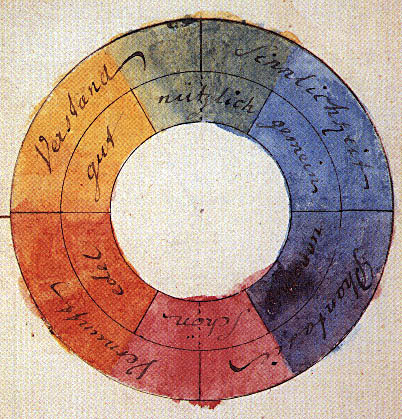
Goethe had described colors as arising where light meets darkness: yellow when light is seen through a slight haze, blue when darkness is seen through a lit medium. Steiner took this observation further. Where Goethe studied how colors appear to the eye, Steiner asked what they mean to the soul. The result was what is often called anthroposophic color theory.
Role of Colors in Art
Steiner worked as a painter, sculptor and architect himself. His most ambitious project was the first Goetheanum in Dornach near Basel, a large wooden building with two intersecting domes, begun in 1913. Its interior featured ceiling paintings made with plant-based pigments and tall windows of colored glass, each in a single hue with motifs engraved into the surface. Light passing through the glass filled the hall with shifting color. The building burned down on New Year’s Eve 1922, and the second Goetheanum, built in concrete, was completed in 1928 after Steiner’s death.

Color also plays a central role in eurythmy, the art of movement Steiner developed from 1912. Performers wear flowing garments and veils in carefully chosen colors, and Steiner designed a series of eurythmy figures in which three colors indicate the movement, the feeling and the character of a sound.
In Waldorf schools, which began in Stuttgart in 1919, children paint with watercolor on wet paper. The colors run into each other, and pupils learn to experience how yellow, red and blue behave before they ever draw a figure. Many adult painters use the related veil technique (Lasur), building up thin, transparent layers of color until depth and light appear.
Colors in Healing and Therapy
Steiner believed that colors act on the whole person, and he saw painting as a way to restore balance between body, soul and spirit. From this idea grew anthroposophic art therapy, where clients paint with specific colors and techniques chosen for their situation. The painter Margarethe Hauschka founded a school for this form of therapy in Germany in 1962, and it is still practiced in anthroposophic clinics today.
In practice, a therapist might ask a restless person to work with calm blue surfaces, while someone lacking energy is guided toward red and yellow. The aim is not to produce a beautiful picture but to let the experience of color itself do the work.