
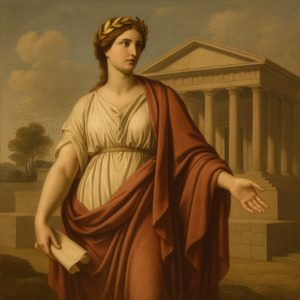
Neoclassicism, also known as the neoclassical style, refers to an artistic and architectural movement that emerged in the late 18th century and flourished throughout the 19th century. The movement was inspired by classical Greek and Roman art and architecture and sought to revive or reinterpret these classical ideals within a modern context.
The Emergence and Development of Neoclassicism
Neoclassicism arose as a reaction to the ornate and decorative styles that dominated the Rococo and Baroque periods. It promoted a purer, more symmetrical, and harmonious aesthetic based on the ideals of ancient Greece and Rome. Architects such as Andrea Palladio and sculptors like Antonio Canova were key figures within this movement.
The neoclassical style had a profound influence on architecture, painting, sculpture, literature, and music throughout the 19th century and into the 20th. It became especially popular for public buildings, monuments, and institutions that wished to embody ideals of democracy, order, and stability—particularly within national or civic contexts.
Neoclassicism also experienced a revival in the 20th century, particularly in architecture and design, where a minimalist approach to form and material continued to appeal to certain architects and artists.
Famous Buildings in the Neoclassical Style
Neoclassical architecture can be seen in some of the world’s most iconic buildings, many of which continue to define the civic and cultural identity of their nations. These works exemplify the style’s characteristic symmetry, grandeur, and reference to classical antiquity. Below are some of the most notable examples:
The Panthéon, Paris (1758–1790) – Architect: Jacques-Germain Soufflot. Originally built as a church, the Panthéon became a monument to France’s national heroes. Its grand portico and Corinthian columns are hallmarks of neoclassical design.
The United States Capitol, Washington D.C. (1793–1826) – Architects: William Thornton, Benjamin Henry Latrobe, and Charles Bulfinch. One of the most recognizable neoclassical buildings in the world, it combines Roman architectural forms with American symbolism, emphasizing democracy and civic order.
The British Museum, London (1847) – Architect: Sir Robert Smirke. Designed with a Greek Revival façade, its monumental columns and pediment reflect the ideals of classical beauty and intellectual pursuit.
La Madeleine, Paris (1807–1842) – Architects: Pierre-Alexandre Vignon and Jean-Jacques-Marie Huvé. Built in the form of a Roman temple with massive Corinthian columns, the church exemplifies the grandeur and solemnity of neoclassical religious architecture.
The Brandenburg Gate, Berlin (1788–1791) – Architect: Carl Gotthard Langhans. Inspired by the Propylaea in Athens, this monument became a symbol of peace and unity, showcasing the balance and proportion central to the neoclassical style.
Christiansborg Palace, Copenhagen (1733–1928) – Architects: Elias David Häusser, Christian Frederik Hansen, and Thorvald Jørgensen. Although reconstructed several times, parts of the palace reflect neoclassical principles in their symmetry, columns, and restrained ornamentation.
The Altes Museum, Berlin (1823–1830) – Architect: Karl Friedrich Schinkel. It represents one of the purest examples of neoclassical museum architecture, emphasizing clarity, balance, and grandeur.
The White House, Washington D.C. (1792–1800) – Architect: James Hoban. Combining classical symmetry with elegant simplicity, the White House illustrates how neoclassical ideals were adapted in early American architecture.
These buildings showcase how neoclassicism became a global architectural language—used to express ideals of democracy, stability, and cultural refinement that remain influential in modern design.
Artistic Characteristics of Neoclassicism
- Purity and harmony: Neoclassicism seeks purity and harmony in form and composition, often using clean lines, geometric balance, and symmetry.
- Inspired by antiquity: The movement draws heavily on the artistic and architectural traditions of ancient Greece and Rome, reflected in the use of classical ornaments, columns, arches, and geometric forms.
- Idealization of the human form: In sculpture and painting, neoclassicism idealizes the human body according to classical Greek and Roman aesthetics—balanced proportions, graceful posture, and harmonious lines.
- Historical and literary themes: Neoclassical works often explore historical, literary, or mythological subjects with a moral or didactic tone, depicting heroes, mythic figures, or classical narratives.
- Monumentality: Neoclassicism favors monumentality, particularly in public architecture and sculpture, expressed through large scale, impressive façades, and strong proportions.
- Restraint in decoration: Unlike Rococo and Baroque styles, which were marked by ornate decoration, neoclassicism favors simplicity and clarity of form over excess ornamentation.
These artistic principles define the neoclassical aesthetic, linking modern creativity with the ideals of classical antiquity while adapting them to contemporary sensibilities.
Other Notable Aspects of Neoclassicism
Historical Context: Neoclassicism arose as a reaction to the elaborate styles of the Baroque and Rococo periods. The movement developed during a time of political and social upheaval, including the American and French revolutions, when democratic and republican ideals gained prominence. Neoclassicism thus became a visual expression of a search for order, rationality, and stability in a changing world.
Architecture and Urban Planning: Neoclassicism had a major influence on architecture and city planning during the 18th and 19th centuries, particularly in the design of public buildings, monuments, and civic spaces. Government buildings, museums, libraries, and universities were often constructed in a neoclassical style to symbolize stability, authority, and intellectual prestige.
Significance in Art History: Neoclassicism marked a return to classical ideals and played a crucial role in shaping the art and architecture of the 19th century. It laid the foundation for later movements such as academic classicism and the modern classical revivals of the 20th century.
International Influence: Neoclassicism spread widely across Europe and reached other parts of the world, including North America. It was adapted to local traditions and tastes, resulting in regional variations that reflected the culture and identity of each nation.
Criticism and Legacy: Despite its popularity, neoclassicism faced criticism from artists and architects who sought greater freedom of expression and innovation. Because of its association with authority and institutional power, it was later challenged by more radical and experimental movements, yet its principles of clarity, balance, and proportion continue to inspire art and architecture today.
FAQ about Neoclassicism
Neoclassicism is an artistic and architectural style that emerged in the late 18th century as a revival of the classical ideals of ancient Greece and Rome. It is characterized by symmetry, simplicity, and harmony.
Neoclassicism developed in the second half of the 18th century and flourished during the 19th century as a reaction against the decorative Baroque and Rococo styles.
Neoclassical architecture is defined by balance, proportion, geometric form, and inspiration from ancient temples. Buildings often feature columns, pediments, and simple, harmonious façades.
Notable Neoclassical buildings include the Panthéon in Paris (Jacques-Germain Soufflot), the White House in Washington D.C. (James Hoban), the British Museum in London (Robert Smirke), the Brandenburg Gate in Berlin (Carl Gotthard Langhans), and Christiansborg Palace in Copenhagen (Elias David Häusser, C.F. Hansen, and Thorvald Jørgensen).
Classicism appeared earlier and adhered closely to the ideals of ancient art and architecture. Neoclassicism came later, reinterpreting those principles through Enlightenment values of reason, order, and modernity.
Neoclassicism gained popularity as a reflection of Enlightenment ideals emphasizing reason, morality, and civic virtue. The style was widely used for public buildings representing democracy, authority, and cultural refinement.
Neoclassicism’s focus on proportion, clarity, and balance continues to influence modern architecture. Many contemporary buildings still draw upon its principles to create harmony, simplicity, and timeless design.