
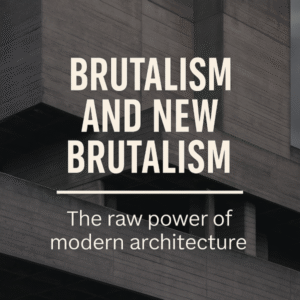
Brutalism is an architectural style that emerged in the mid-20th century. It is characterized by its rough, raw concrete constructions, often with visible reinforcement bars and a minimalist aesthetic.
The term Brutalism comes from the French word brut, meaning “raw” or “unfinished,” referring to the exposed and unpolished appearance of concrete. The style arose as a reaction against the more decorative and elegant forms of modernist architecture that dominated the mid-1900s.
Brutalism gained popularity during the 1950s and 1960s and was widely used for public buildings such as universities, libraries, housing complexes, and administrative institutions. Many of these structures are known for their massive scale and monumental presence in urban spaces.
Although Brutalism has often been criticized for its utilitarian and harsh appearance, many of its buildings are now recognized as important examples of modernist architecture and have been preserved as cultural landmarks.
Influential Architects of Brutalism
Some of the most notable architects associated with the development of Brutalism include:
- Le Corbusier
- Louis Kahn
- Alison and Peter Smithson
- Paul Rudolph
- Marcel Breuer
- Alison Brooks
- Denise Scott Brown
- Jane Drew
- Lina Bo Bardi
- Alison Killing
Le Corbusier
Le Corbusier was one of the key architects who helped shape Brutalism. As an early pioneer of modernist architecture, he was known for his innovative use of concrete and steel in building design.
He created several buildings famous for their raw, minimalist appearance, including Cité Radieuse in Marseille, France, and Unité d’Habitation in Berlin, Germany. These projects were groundbreaking in their use of exposed concrete and large geometric forms.
Le Corbusier’s work reflected his functionalist philosophy — the idea that buildings should be designed around how people use and move within them. He sought to create efficient, practical structures that served the needs of modern life.
Today, Le Corbusier is considered one of the most influential architects of the 20th century, and his contributions to Brutalism continue to shape contemporary architectural thought.
New Brutalism
New Brutalism — also known as “Nybrutalisme” — developed from the original Brutalist movement during the 1950s and 1960s. It retained many of the core principles of Brutalism but placed greater emphasis on decoration, human scale, and detail.
While still favoring raw concrete and unpolished materials, New Brutalism introduced more decorative elements and user-friendly designs. Functionality and accessibility became increasingly important features of this architectural style.
The movement was especially popular in the United Kingdom and the United States during the 1970s. Many New Brutalist buildings are recognized for their massive scale, geometric forms, and extensive use of concrete and steel. Although the style is less dominant today, examples of New Brutalism can still be found worldwide.
Hans Asplund
Hans Asplund was a Swedish architect and one of the leading figures in the New Brutalist movement in Sweden during the 1960s and 1970s. He was known for his work with raw concrete and steel structures — hallmark features of New Brutalist design.
Asplund is particularly famous for designing the Västerås City Hall in Sweden, completed in 1967. The building is noted for its monumental scale, angular geometric form, and rough concrete surfaces. It is now regarded as one of the most iconic examples of New Brutalist architecture in Sweden.
In addition to his civic projects, Asplund worked on residential complexes, schools, and museums. He was admired for his innovative approach and commitment to creating architecture that was both functional and visually striking.
Though New Brutalism is no longer a dominant style, Hans Asplund’s work remains relevant and continues to influence architectural design in Sweden and beyond.

Overview: Key Characteristics of Brutalist Style
The Brutalist style can be recognized through several defining traits:
- Raw concrete: Buildings are typically made of unfinished concrete, often left exposed to highlight the material’s natural texture. Casting marks and imperfections are visible as a statement of honesty and process.
- Strong geometric forms: Structures feature bold, angular, and geometric shapes, giving them a striking, monumental appearance. Some critics view this as inhuman or imposing.
- Functionalism: Brutalist buildings are designed to meet practical needs rather than prioritize beauty. Large housing projects, for example, aimed to accommodate many people efficiently, resulting in massive, repetitive structures.
- Exposed structures: Beams, columns, and other structural elements are often visible, emphasizing an industrial and raw aesthetic.
- Large scale: Brutalist architecture often uses grand proportions that dominate the surrounding landscape.
- Minimalism: The style avoids unnecessary ornamentation and focuses on simple, powerful forms.
- Social awareness: Many Brutalist buildings were designed with a social mission — to be inclusive, accessible, and utilitarian for all, regardless of social class.
These characteristics define Brutalism as a movement that combined architectural honesty, social purpose, and a bold visual identity. Despite its polarizing reputation, Brutalism remains one of the most distinctive and influential architectural styles of the modern era.

